
 This is it – can you believe it? We’ve reached the final week of our four-week routine challenge. Over the past three posts, we’ve learned about the importance of maintaining a daily routine for increased productivity, time management, and balance. We’ve established an effective bedtime routine so we get those important 7-8 hours of sleep a night. And we’ve created an efficient, realistic morning routine that carves out “me time” before the day officially begins.
Today we finish the last leg of this journey by establishing a routine for our day-to-day tasks. We will discover different strategies to best manage our time so we accomplish our goals while also having fun.
Are you with me? Let’s do this.

Create a daily routine
Now, I know there are a few of you out there thinking – “Okay, I can get behind the bedtime routine and the morning routine…but do I REALLY need to schedule my entire day as well??”
Yep.
But let me explain.
As I’ve stressed in my earlier posts, my definition of a daily routine is not a strict, unchanging, set-in-stone, list of “to-dos.”
Rather, my definition of a daily routine is establishing a handful of daily tasks that help with efficiency, productivity, organization, and/or self-reflection. By turning to these activities with regularity, you create pockets of consistency in your life. This consistency, in turn, provides comfort and stability.
Occasional comfort and stability is incredibly beneficial for busy-awesome people like you and me.
Two different categories
To create the perfect daily routine, I recommend coming at it from two different angles: the everyday “work stuff,” and the valuable “you stuff.” (Highly scientific language here, people).
With the “work stuff,” I am referring to the tasks and projects you need to do for your job.
Now, the word job holds many meanings here: it might be a regular 9-5 model, but it could also be a junior in college managing her classes, a stay-at-home-parent handling every detail of family life, or an entrepreneur simultaneously balancing several new projects. Wherever you fit in this spectrum, the “work stuff” category contains the things you need to do each day for your job.
The “you stuff,” (aka the fun stuff!) is all about the things you need or want to do each day. And you want to do these tasks because they’re important to you, be it mentally, physically, spiritually, or emotionally.
This “you stuff” category is no less important than the “work stuff” one. That being said, it often gets pushed to the wayside when life gets busy.
This is precisely why I include the “you stuff” category in our daily routine process; it is important for our emotional and physical wellbeing, and it therefore deserves equal attention in our day-to-day activities.
So how do we create our routine with these two different categories? Let’s tackle it step by step, starting with the workday.
The “work-stuff”
Before we start planning out the specifics, let’s first make a list of the regular tasks you do each day. This will look different for everyone, but the process is generally the same.
Some of these tasks are pretty straightforward: Check emails, answer voicemail, grade homework etc. There are other things, however, that aren’t quite so black and white:
You: “But Paula, I don’t do the same tasks each day. I teach on Tuesday and Friday, I have Faculty meetings on Thursdays, I meet with my writing group on Mondays…”
Okay. I hear you. No problem.
Try stepping back and looking at the bigger picture. You might not do the exact same thing every day, but I bet you do the same thing within a general category each day.
Teachers, do you work on class prep each day? Business people, do you check in with clients each day? Bloggers and entrepreneurs, do you do some form of blog advertising/promoting each day? Stay-at-home-parents, do you work on household upkeep (laundry, dishes, floors, bedding) each day?
I thought so.
Create your list
So consider all of the different projects you tackle each week, place these specific tasks in larger categories, and create a list of your daily tasks. Mine looks like this:
- Answer emails
- Class prep
- Grading
- Research/Writing
- Meetings
Peak productivity
Now that you have your list, the next step is considering what time of day you are most productive. Everyone has their *peak* time of day as well as their, “I need toothpicks to keep my eyes open” time of day (for me, that time is between 3:00-4:00 p.m.)
By knowing what time you work the best, you will have an easier time setting your schedule.
Create that schedule
Okay, you know your list of general tasks, and you’ve highlighted your peak times of productivity throughout the day. Now it’s time to create that schedule.
Look at your list of things to do. Keeping your peak productivity times in mind, begin planning your work routine.
I recommend breaking your day into 30 minute or 60 minute increments with 5-10 minute breaks in between. Fill in the hours of your workday with your list of to-dos, and concentrate your most demanding tasks during your hours of peak productivity.
Now, putting this approach in practice might feel strange at first, because you might not finish everything in one sitting. Instead, once you reach the end of your time block, take pride in what you accomplished. Then, move on to the next task.
*Remember,* you don’t need to stress if you don’t get everything done in one sitting; you know you can come back to it at the same time tomorrow. Why? Because this is a daily routine.

Let’s get specific
As a reminder, although you created broader categories to establish your daily routine, you can always get more specific when you plan out your to-do list for the day. For example, take a look at my daily routine compared to my specific daily list:
Daily Routine
- 8:00-9:00 Research
- 9:10-10:10 Research/Writing
- 10:20-11:00 Class Prep
- 11:00-11:30 Lunch (I know – super early…but I get up at 4:15, so by 11:00 I’m starving – ha!)
- 11:30-12:30 Class Prep
- 12:40-1:10 Grading
- 1:20-1:50 Emails
- 2:00-3:00 Meetings
- 3:00-3:30 Odds and Ends
Monday to-do
- 8:00-9:00 Research – read Copland book
- 9:10-10:10 Research/Writing – expand on chapter 2
- 10:20-11:00 Class Prep – office hours and review readings for the week.
- 11:00-11:30 Lunch
- 11:30-12:30 Class Prep – prepare Tuesday’s lecture
- 12:40-1:10 Grading – grade papers
- 1:20-1:50 Emails
- 2:00-3:00 Meetings – CTL Meeting
- 3:00-3:30 Odds and Ends
By knowing specifically what you need to accomplish each day, and what time you will tend to each task, you avoid wasting time wondering, “What should I work on next?” What’s more, by recognizing when you are at your peak performance, you increase your efficiency and get more accomplished each day.
Okay, that’s the “work stuff.” What about the “you stuff?” What about the other hours of the day that you’re not at work? This is the fun part.

The “you stuff”
For both your bedtime and morning routines, I’ve asked you to reflect on things you would like to do more often in your life but feel like you don’t the time.
Guess what, I am going to ask you the same thing once again for your daily routine.
- What are the things that make you feel happy?
- Are there certain activities that help you relax after a long day?
- What makes you feel alive?
- When do you feel most loved and at peace?
Take a moment and look at your answers to the above questions. These are the things you need in your life every day. In order for you to keep going strong day after day with your ‘work stuff,” there must be time for YOU. Now, I realize it might not be realistic to fit all of your above answers in your daily routine each day.
But just like we did before, let’s step back a bit. Let’s break the “you stuff” list into three broad categories:
- What makes me feel good physically?
- How can I feel good mentally?
- What helps me feel good emotionally?
If you can tend to these three questions each day by fitting them into your daily routine, you’re on your way to one of the most important tasks of all: taking care of yourself.
[bctt tweet=”Remember – you can’t pour from an empty cup.” username=”BusyBeingPaula”]
Create your “you” routine
So again, use these three questions as an interchangeable template for your daily routine. My Monday might look like this:
- 4:00-5:00: Physical – Walking: Take Bruno for a walk
- 5:30-6:30: Emotional – Connections: Make dinner with Ryan
- 7:30-8:30: Mental – Read: Catch up on my favorite bloggers’ latest posts.
And just like that, you’ve established your ideal, flexible, daily routine. You get the every-day necessities done quickly and efficiently while – most importantly – saving time for what’s important to you.
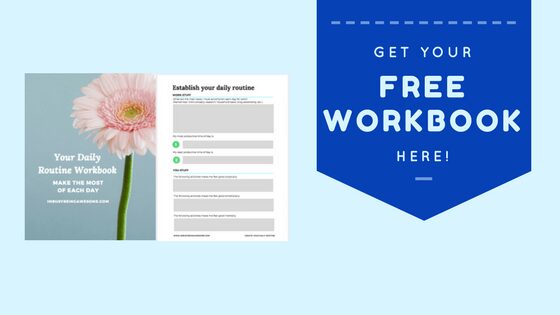
Are you ready to create your own daily routine? Download your FREE workbook here and get started TODAY!
Are you looking for the other posts in this series? Check them out here!
How to maximize your productivity by following a routine
Create your perfect bedtime routine in three easy steps
How to create your ideal morning routine
How to create a flexible daily routine (you’re here now!)
Have we connected on Facebook? Click on the “like” bar at the bottom of the screen and get extra tips and strategies in your feed!