
Have you ever bought a planner and ditched it by Wednesday?
If you’re nodding along… you’re not alone.
You start the week with a beautiful new planner, full of good intentions and color-coded ambition. But by midweek, it’s already gathering dust.
Cue the familiar cycle: excitement, abandonment, self-blame.
Sound familiar? Yeah. Me too.
I’ve absolutely been the person with 17 planners (some still in the plastic wrap) hoping, “This time will be different.” I’ve convinced myself that the perfect planner will finally unlock my focus and follow-through. Spoiler alert: it didn’t.
But here’s the thing: this isn’t a character flaw. It’s not laziness. It’s not a lack of discipline.
It’s a mismatch.
Traditional planning systems assume linear thinking, consistent energy, and zero executive dysfunction—things that just don’t align with how many ADHD brains work.
So let’s stop trying to force our square-peg brains into round-hole schedules. Instead, let’s explore one powerful mindset shift that can make planning with ADHD actually feel supportive.
Listen to the episode above or stream it on your favorite podcasting app. Prefer to read? No problem! Keep scrolling for a summary of key takeaways.
In Episode 336 we’re exploring:
- The iteration mindset that replaces perfectionism with progress when planning with ADHD
- How to build in flexibility without losing structure entirely
- The one reframe that makes scheduling feel like support instead of suffocation
Episode 336: How to Plan with ADHD (Without Getting Overwhelmed) (Transcript)
Planning Isn’t a Scorecard
Let’s reframe what a plan is… and more importantly, what it’s not.
When we’re learning how to plan with ADHD, one of the biggest mindset shifts is remembering this:
Your schedule is not a moral report card.
If your brain has internalized years of planner shame, it makes sense that you’d resist making plans in the first place. That’s why we need to redefine the role of a schedule in our ADHD toolkit.
A plan is NOT:
- A measure of your worth or productivity
- A rigid set of rules you must obey to “get it right”
- A system that only “works” if followed perfectly
A plan IS:
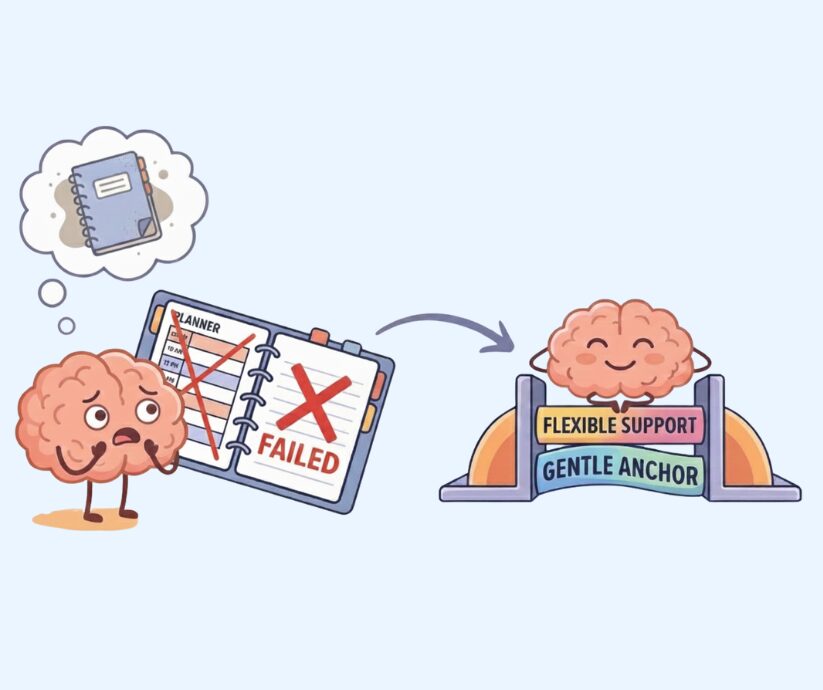
- A flexible support system that helps you navigate your day
- A way to reduce decision fatigue and overwhelm
- A gentle anchor that helps you re-orient when life goes sideways
Think of your ADHD-friendly plan like bookends: it doesn’t control what’s between them, but it keeps your time and tasks from toppling all over the place. It holds space for intention while leaving room for flexibility.
When we stop treating planning as a performance and start seeing it as a supportive structure, everything changes.
This is how we begin planning with ADHD brains in mind: compassionate, realistic, and rooted in real life.
Why Our Brains Rebel Against Rigid Plans
Here’s what makes traditional planning systems so tricky for ADHD brains and why learning how to plan with ADHD means unlearning a lot of those rigid rules.
Most planning systems were designed for neurotypical brains that assume linear thinking, steady motivation, and executive function that’s always “on.” That’s not our reality.
Our ADHD brains are often managing:
- Executive dysfunction that makes getting started feel impossible
- Emotional dysregulation that can shift the entire day
- Time blindness that skews how long tasks actually take
- Energy fluctuations that make 10 AM feel totally different from 2 PM
- Perfectionism and all-or-nothing thinking that sabotage our follow-through
So when a plan doesn’t go perfectly, we don’t just adapt, we blame ourselves. We internalize it as failure: “I’m terrible at this. I’ll never be consistent. Why even try?”
A plan is not a test. It’s a tool.
But here’s the reframe:
What if the plan wasn’t broken? And you aren’t either?
What if the planning system just wasn’t built for your brain?
This is why planning with ADHD needs to be flexible by design. It needs to bend and adjust with your real life, your real energy, and your real patterns.
And that shift? That’s where the real freedom starts.

The Iteration Mindset: Version 1.0 is Enough
Here’s the mindset shift that completely transformed how I plan with ADHD and also how I teach it to my coaching clients:
Stop aiming for perfect. Start iterating.
Iteration is the foundation of ADHD-friendly planning. It’s how we ditch the pressure to get it “right” and build systems that evolve with our real life.
Instead of treating your schedule like a final exam, treat it like a working draft. It’s a curious experiment. You’re not being graded. You’re gathering data.
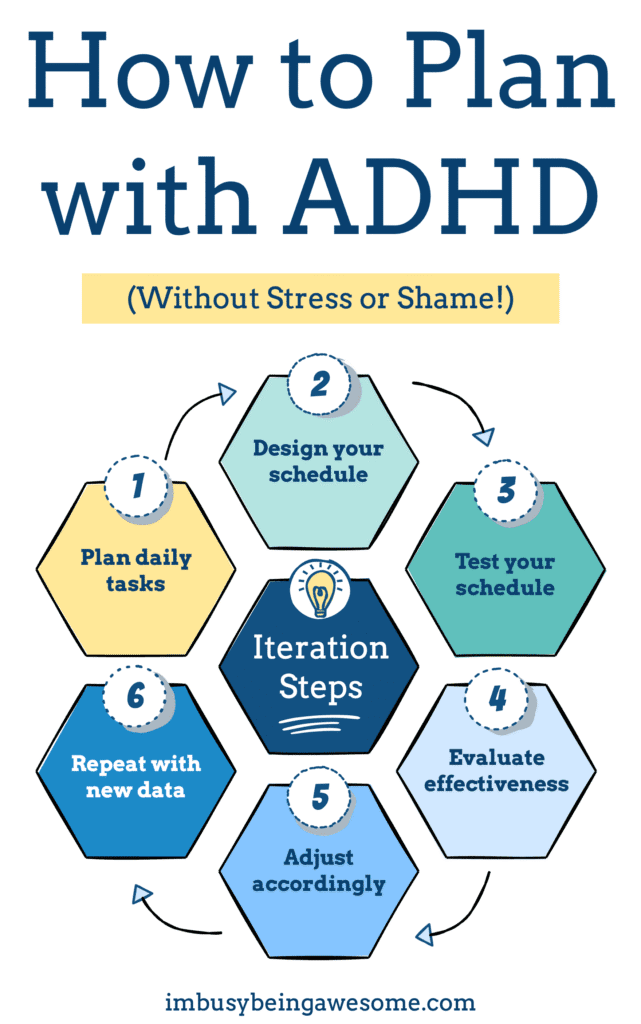
Here’s how to plan with ADHD using the iteration model:
- Plan your day with a few focused intentions.
- Live the plan and see how it plays out in real life.
- Reflect on what worked and what didn’t.
- Adjust based on your brain’s actual needs.
- Repeat with less shame and more clarity.
That’s it. Plan, test, learn, tweak. No gold stars required.
For example: one client realized she always got pulled into emails during her best creative window. With this data, she shifted email to the afternoon. One tiny tweak=huge results.
This is the power of iteration. You’re not planning for some ideal version of yourself. You’re planning for the brain and life you actually have. And that’s where sustainable systems come from.
Learning how to plan with ADHD means embracing the messy middle. That’s not a flaw, it’s the path.
But What If I Never Stick To It?
If your brain is whispering, “Why bother planning if I never follow through?” I hear you.
This is one of the most common (and completely valid) questions I get:
“What’s the point of making a plan if I’m just going to abandon it by lunch?”
Here’s the reframe:
The goal of planning with ADHD isn’t to lock yourself into a rigid schedule. It’s to give your brain a place to land when the day goes off course. And it will.
We’re building a tether that helps us return to focus.
Because without a plan, our default often looks like this:
- Spinning in decision fatigue
- Chasing distractions to avoid discomfort
- Losing track of what matters most
But with even a loose ADHD-friendly plan, we have something to return to. A home base.
So when your kid gets sick, your brain hijacks your focus, or your schedule explodes? You can pause and ask:
- What time block am I in?
- What was my non-negotiable today?
- What’s the next right thing I can come back to?
This is why learning how to plan with ADHD isn’t about perfection. It’s about having a gentle, flexible framework that helps you re-enter your day without shame.
Your plan isn’t there to trap you. It’s there to guide you back to what matters, again and again.
How to Plan with ADHD in a Way That Actually Helps
If you’re ready to try planning in a way that supports your brain, here’s a gentle place to begin. You don’t need to overhaul everything at once. Start small and build as you go.
Here’s a simple roadmap:
- Identify one priority for the day. What’s the one thing you’d like to move forward?
- Set aside focused time to work on that one thing. Even 20 or 30 minutes can make a big difference.
- Add buffer space between tasks, appointments, and transitions. Give your brain room to breathe.
- Pause and reflect at the end of the day. Ask yourself: What went well? What felt sticky? What might help next time?
The goal is to create a flexible rhythm that helps you return to your focus when needed. Think of your plan as a support tool, not a strict rulebook.
And the most important part? Give yourself plenty of grace. Planning with ADHD is not about getting it right every time. It’s about learning more about how you work and what helps.
Every day is an opportunity to gather data and make small adjustments. Every plan is a step toward building a system that works with your brain, not against it.
👉 Ready to apply these Concepts to your life?
Here’s how we can work together:
- 6-Month Private Coaching
- We’re Busy Being Awesome (small group coaching)
- Overwhelm to Action (self-paced course)
Want Help Planning with ADHD in a Way That Fits Your Brain?
If you’re ready to go deeper and build a planning system that actually works for you, I’d love to invite you to join us in the next round of We’re Busy Being Awesome.
Inside the program, we:
- Build personalized, ADHD-friendly planning routines
- Practice using the iteration mindset in real-time
- Explore practical tools for focus, energy, and follow-through
- Learn to plan without pressure, shame, or all-or-nothing expectations
You can join the waitlist or learn more at imbusybeingawesome.com/group.
And if you’re curious about your own ADHD overwhelm pattern, you can take my free Overwhelm Type quiz. It’s a great first step toward understanding what gets in your way and how to move forward with clarity.
Discover Your ADHD Overwhelm Type!
In less than a minute, you’ll discover your primary overwhelm pattern, understand the obstacles it creates, and get tailored strategies designed for your brain’s natural response style.
You don’t have to figure this out alone. We’re in this together, and your brain is absolutely worth supporting in ways that truly work.
You’ve got this.
TL;DR: How to Plan with ADHD (Without Shame or Stress)
If you’re short on time, here’s the quick version:
- Traditional planners often don’t work for ADHD brains because they expect consistency, rigidity, and task initiation that can feel out of reach.
- A helpful plan is flexible, supportive, and designed to reduce overwhelm—not something you have to follow perfectly.
- One of the most powerful mindset shifts is learning to iterate, not perfect. Try, learn, adjust, and try again.
- You’re not doing it wrong if your day goes off course. That’s part of the process.
- Your plan is a tool that helps you reorient and refocus when needed.
Every day is another opportunity to learn what supports your brain. You don’t need to get it right on the first try.
You’re not broken or behind. You’re just learning how to plan with ADHD in a way that actually works for you.
And that? That’s worth celebrating.


About Paula Engebretson
ADHD COACH | PODCASTER
I spent the first 31 years of my life thinking I just needed to “try harder” while dealing with crushing self-doubt, perfectionism, and imposter syndrome. Then I was diagnosed with ADHD.
Finally understanding the missing puzzle piece, I discovered how to work with my brain, build upon my strengths, and take back control of my life.
Now I help others with ADHD do the same. Learn more.