Does it ever seem like your ADHD brain is wired for busyness over happiness? Is it hard to appreciate your accomplishments when your mind focuses solely on the never-ending to-do list? If this sounds familiar, you’re not alone.
In fact, many of us ADHD brains struggle with this very obstacle, but what if there’s a way to change that pattern? What if your ADHD brain naturally found happiness amidst the busyness of daily life? What if you could boost your enjoyment of the day-to-day overall?

In episode 261 of the I’m Busy Being Awesome podcast, we’re exploring a simple yet powerful framework to create happiness in your ADHD life.
You can listen to the episode above or stream it on your favorite podcasting app here.
Prefer to read? No problem! Keep scrolling for a summary of the key takeaways.
Before we jump in, check out my latest group coaching program – I’d love to see you there!
Join Our Group Coaching Program – We’re Busy Being Awesome!
Add your name to the waitlist!
A four-month small, supportive group coaching program for adults with ADHD and ADHD tendencies.
To learn more check out We’re Busy Being Awesome. Are you ready?
–
This post contains affiliate links, meaning I may earn a small commission if you make a purchase through my links, at no extra cost to you. Disclosure info here.
Episode 261: 3 Secrets To Be Happy When You Have ADHD (Transcript)
Here You Will Discover:
- Happiness is a practice, not a destination
- A powerful, 3-step framework to creating more happiness in your ADHD life
- How to put this framework into practice today
Today’s episode was inspired by a screenshot of a post from X a few weeks ago, and I’ve been thinking about it a lot recently. It’s a simple post of 5-6 sentences, but within the simple sentences are some profound points that have stuck with me.
Today I thought I’d share the original post with you and some of the things I’ve been thinking about as well. The post comes from someone named Lauren Wilford. I’ll share the original here first:
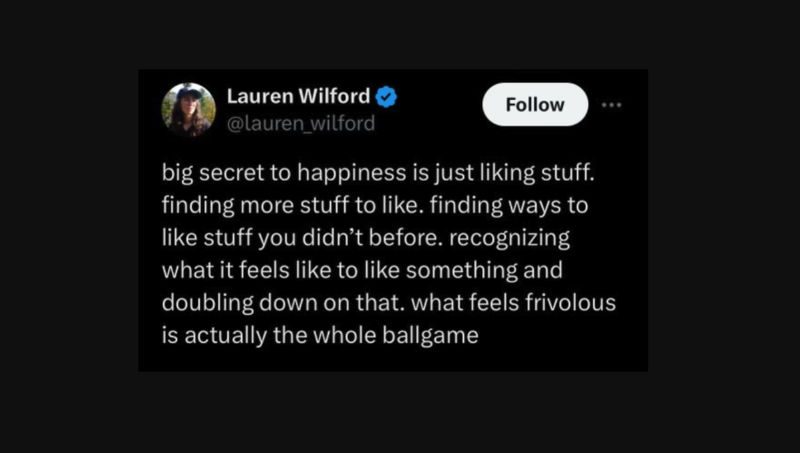
“big secret to happiness is just liking stuff. finding more stuff to like. finding ways to like stuff you didn’t before. recognizing what it feels like to like something and doubling down on that. what feels frivolous is actually the whole ballgame.” – Lauren Wilford
The big secret to happiness is just liking stuff. I LOVE this idea, and I love how the writer takes this simple, yet true statement and breaks it down further into three steps. So, under the big secret of simply liking stuff, she’s referring to:
- Finding more stuff to like
- Finding ways to like stuff you didn’t before
- Recognizing how it feels to like something and doubling down on that
While there are certainly many layers and, I’m sure, many objections one might have to this simplification, I actually love it. My busy ADHD brain loves having simple steps and a simple framework with one clear goal.
And since many of us are in the pursuit of some version of happiness – whether we actually use the word happy or fulfilled or joyful or purposeful or what have you – I think this framework is a powerful one to explore.
Now importantly – even though it’s a simple framework – it’s not necessarily easy.
Simple does not always mean easy. Simple refers to something that is straightforward, uncomplicated, and lacking in complexity.
It’s a concept that one can grasp relatively quickly. While easy refers to something that requires little effort. Easy means that it usually isn’t particularly difficult to accomplish whatever task or activity we’re considering.
While the writer’s perspective on happiness is a very simple concept that breaks nicely into a simple framework, it’s not necessarily easy to adopt. It might be, but I want to make that distinction before we dive in further.
3 Steps to Find Your Happy as an ADHD Adult

Today, I’d love to dive into what I’m pulling out as a simple three-part framework that I think could be compelling for all of us to consider, whether you’re thinking about your life as a whole or you’re contemplating one area of your life in particular.
You might be looking for:
- Greater happiness
- Fulfillment
- Peace
- Contentment
- Satisfaction in one particular area of your life: like work, your relationships, or your home, a particular hobby or habit or routine you’re working toward.
- Contentment in your overall life
Either way…what would it look like to focus your energy on this framework for the next few weeks?
Let’s look at each one of these in turn.
1. Finding More Stuff to Like
Depending on where you are in your ADHD journey, your current season of life, and how you feel about finding, learning, or starting new things, this first part of the framework might land differently.
When we’re all in: Some of us ADHD brains may jump on board immediately, thriving on novelty and variety. The excitement of diving into new interests and learning new things brings an immediate rush of enjoyment. If this sounds like you, then finding more stuff to like will probably be easy.
Your growth edge will be checking whether your interest is genuine as we talk about in episode 172, or influenced by external “shoulds.” If you love exploring new things, keep going as long as it doesn’t distract from your current priorities or goals. Enjoy the joy of exploration.
Hesitation about liking new things:
Not all of us respond this way. Some may feel hesitant or afraid to pursue new interests due to past experiences of starting projects and not finishing them, leading to feelings of guilt, frustration, or shame. Adding more interests might seem overwhelming, with your brain thinking, “NOPE.”
Challenge these thoughts. Is it true you never finish anything?
Liking more things doesn’t always mean more unfinished tasks. Consider that finishing everything isn’t the goal; the experience of learning and exploration is.
Practice compassion with yourself. It’s okay to try new things without the pressure of mastery or completion. Success can be found in the joy of discovering.
Cynicism about liking new things:
Some might feel cynical about finding and liking new things. This often acts as a shield against past disappointments. And while cynicism can protect from potential failure, it doesn’t align with finding greater happiness and fulfillment.
So rather than asking ourselves open question loops like “What’s the point in trying?” or “Why even bother?” Let’s answer them! “What IS the point?” We want to remind ourselves why it’s worth it to start liking more stuff again.
Why Finding More Stuff to Like Boosts Happiness:
Finding new things to like taps into our natural curiosity, providing excitement and keeping our minds engaged.
This is beneficial for ADHD brains that thrive on stimulation. New interests add variety to our lives, helping us stick with routines that support our goals. This blend of delight and stability contributes to overall enjoyment.
2. Finding Ways to Like Things We Haven’t Before
Step 2 in this simple framework is finding ways to like things we haven’t before. This one is likely a much taller order for many of us. It certainly is for me.
If you’re like me you may have a lot of stories built up about boring, challenging, tedious things.
Often, our initial reaction to certain activities is shaped by past experiences and the stories we tell ourselves. If we’ve found something boring, challenging, or tedious in the past, it’s easy to build up a mental narrative that reinforces these feelings.
These stories become our default perspective, making it hard to see these activities in a new light.
Example: Some classics for many ADHDers are the recurring household tasks of doing laundry and washing dishes. Many of us have stories built up about how these chores are boring, never-ending, and just plain tedious.
Since we’ve had poor experiences with these activities in the past, our brain has collected evidence to prove that laundry and dishes are inherently awful. Each negative experience serves as evidence to support our beliefs.
So if you’ve struggled with a task or found it unenjoyable before (whether it’s laundry or dishes or answering emails or submitting your expense reports) your brain files away this information, reinforcing the idea that the activity is inherently unpleasant.
This cognitive bias can become a self-fulfilling prophecy, where we approach the activity with dread, and therefore, it continues to be a negative experience.
Example: Maybe you’ve had times when laundry piled up to the point where your brain feels completely overwhelmed thinking about where to begin. Or you’ve spent what felt like hours washing dishes only to find more dirty dishes appearing immediately after. These poor experiences make it easy to believe that these chores are never-ending drains on our executive functions. And – I promise you – you will find many people to agree. (Myself included at times)
So we keep reinforcing these beliefs. Cognitive bias plays a significant role here. If we believe an activity is tedious or boring, we tend to focus on the aspects that confirm this belief. What you focus on grows.
This selective attention means that we overlook any potentially enjoyable elements. The more we focus on the negative, the more it grows in our perception, creating a cycle that’s hard to break.
Example: Each time you think about doing laundry or dishes, you recall how much you dislike it. This focus on the negative aspects makes it increasingly difficult to motivate yourself, reinforcing your belief that these chores are inherently unpleasant. The same is true with particular people who may not be your cup of tea or certain habits your partner or sister or child does. Once the brain identifies them as a problem, it looks even more diligently to reaffirm the belief.
What can we do?
One way to start changing our perspective is by moving away from all-or-nothing thinking.
Instead of viewing an activity as entirely good or bad, we can acknowledge that it has both enjoyable and unenjoyable aspects. It’s a both-and. This more nuanced approach can open us up to finding parts of the activity that we can appreciate.
Example: Instead of thinking “I hate doing laundry,” consider that there might be aspects of the task that you could enjoy. Perhaps the satisfaction of seeing all your clothes clean and neatly folded, or the cozy feeling of warm clothes fresh out of the dryer. Or maybe there’s a certain scent you love. Or perhaps you’ve pulled a tip from Atomic Habits, and you’ve paired the act of putting away laundry with listening to your favorite podcast or watching your favorite show. So we can start challenging that all-or-nothing mindset by finding the parts we do enjoy.
So again, to help yourself do this, you can intentionally reflect on the question: what DO I like about this activity? Challenge your brain to pinpoint specific aspects. Even if it’s something small, helping your brain focus on these positive elements can shift your overall perception of the activity.
What COULD be Fun Here?
Consider ways to make the activity more enjoyable. Could you turn it into a game, set a timer to challenge yourself, or involve friends or family to make it a social event? Thinking creatively about how to introduce fun into the task can truly transform your experience.
I also love thinking about someone I know who DOES like this activity; what are their thoughts about it? Sometimes, understanding why someone else enjoys an activity can provide a fresh perspective.
So consider talking to someone who genuinely likes the task you find tedious. Ask them what they enjoy about it and try to see the activity through their eyes. Their enthusiasm and positive viewpoint can be infectious and may help you find new ways to appreciate the task.
In fact, I have a client who has such beautiful thoughts about laundry. She loves to do the laundry and literally hangs the clothes out on the line. She loves the scents and the routine of the practice. I’m telling you, any time I’m dreading getting started on laundry, I channel her energy and I can get that boost and much more easily start finding things I like about the laundry process.
So again, even if we don’t naturally like a task, making the effort to find things we DO like can have a powerful impact on our overall experience for many reasons.
Less Heaviness to Carry Around:
When we learn to find enjoyment in things we disliked in the past, it helps reduce the mental and emotional burden we carry. It helps lift that weight of dread, making us feel lighter and more enjoyable overall.
Moments of Delight Within:
By finding small moments of joy in these activities, we can transform our experience. Even if we don’t love the activity as a whole, appreciating parts of it can make it more bearable and sometimes even enjoyable.
Improved Perspective:
This approach helps us develop a more flexible and positive mindset. Instead of being trapped in a rumination cycle, we open up to finding those moments of joy in otherwise mundane experiences.
It goes without saying that you won’t likely shift your entire perspective and start liking everything you once didn’t. That’s not the goal. That would mean you’re a programmable robot. BUT, we can still bring intention to it. What if we could start liking parts of it?
Again, it’s perfectly human not to love every activity and every experience. We are complex beings with so many different perspectives and preferences. That’s what makes this all so incredible. The key is to find and appreciate the parts that do bring us joy, no matter how small.
Example: Even if you never become a fan of laundry or dishes, you might find that you enjoy the meditative aspect of these tasks or the satisfaction of a clean home. These small joys can make household chores a more positive part of your life, rather than something to dread.
3. Recognizing How It Feels to Like Something and Doubling Down on This

Over my years of coaching and doing my own work, I’ve noticed that we often get stuck in patterns. We develop these habitual emotional responses based on our past experiences, and we keep repeating these patterns, ingraining them further.
Over time, our nervous system becomes conditioned to these familiar feelings, whether they are positive or negative. This conditioning can make it challenging to break free from old patterns and embrace new, more positive experiences.
It’s kind of like having the grand canyon of thought patterns – we’ve gotten used to thinking and feeling a certain way – and then all of a sudden we’re trying to create a distributary where we’re branching off in a new direction. This can be uncomfortable and unfamiliar.
In fact, I’ve found that many of us are actually quite uncomfortable or uneasy with feeling more “positive” or comfortable emotions like happiness, contentment, joy, delight, and satisfaction.
We might question whether we deserve to feel this way since we haven’t gotten everything done yet, or we messed up in another area, or we dropped the ball before.
We struggle to allow ourselves to feel something like confidence or happiness or accomplishment because we’re waiting for the other shoe to drop. This fear of the other shoe – can keep us from fully embracing and enjoying the moments of joy and satisfaction that come our way.
What can we do here?
How can we start recognizing how it feels to like something and double down on it?
I first want to mention that if you’re really struggling here and it not only feels uncomfortable but actually feels unsafe, the first step is simply noticing.
From there, I’d suggest reaching out to work with a trauma-informed therapist who can help you potentially work through anything that might be blocking you from experiencing these more enjoyable emotions.
However, if it’s more of a discomfort and unfamiliarity you’re experiencing or if it’s more of a habitual pattern where your body and mind just naturally divert to the uncomfortable side, rather than naturally feeling content or pleasurable or happy, your brain has simply practiced feeling unsettled, frustrated, anxious, worried more often, then the key is in curiosity and willingness.
Are you open to the idea of experiencing and acknowledging positive emotions?
Are you open to expanding your capacity to be with this new feeling?
I know it sounds strange because – yes – I’m asking you if you’re willing to sit with happiness and contentment. But I’m teling you, this can be VERY uncomfortable for those of us who are always go-go-go and think we need to prove and hustle and fix and do.
By intentionally recognizing and appreciating the things we like and allowing ourselves to expand our capacity to truly ENJOY that experience of liking it, we then expand our capacity to experience happiness more frequently and deeply.
In his book The Big Leap, Gay Hendricks introduces the concept of the “upper limit problem,” which is the idea that we all have an internal thermostat setting that determines how much can experience and allow success and happiness in our lives.
When we exceed our upper limit, we often unconsciously do things to return to a level of comfort that feels familiar.
Example
I’ll give an example of what this has looked like on my journey of stepping to more stillness this year since my word of the year is Be Still.
If I’m really leaning into that stillness. If I’m relaxing and simply enjoying a book or sitting out on the deck in the sun with Bruno and having a slow Sunday morning, my brain will suddenly shift. And it will offer 15 things I could be doing that’s more “productive.”
Maybe you should focus on that productivity book on your Kindle rather than this Emily Henry book that you can’t put down. Or maybe, rather than just sitting here with Bruno, you could do that while also looking for some new meal ideas since your usual rotation is a bit tired and you should really…. Blah blah blah.
Suddenly, my mind has reached that point of discomfort where it no longer feels good to be doing something restful since my nervous system is so used to “go mode.”
Hendricks uses the analogy of a thermostat to explain how this works.
Just like a thermostat regulates the temperature in a room, our internal thermostat regulates our emotional state.
- If the room gets too warm, the thermostat kicks in to cool it down
- And if it gets too cold, it heats things up
So when I’m sitting with a book and Bruno and enjoying myself, suddenly, my thermostat has gotten too high, and my brain naturally wants to cool down back to my regular “comfort zone.” And vise versa – there are times when things get way too chilly, and I my body is craving that downtime and stillness, and my brain naturally kicks on to warm it back up since I’ve dropped below my comfort zone.
Raising the Thermostat Setting: Hendricks suggests that we can work on raising our thermostat setting to allow more positive experiences into our lives. This involves becoming aware of our upper-limit behaviors and challenging the beliefs that keep us stuck in our comfort zone.
For now, I think it’s important to start creating awareness of where that comfort zone is. As a reminder, part three of increasing greater happiness and enjoyment in our lives – according to this framework – is recognizing how it feels to like something and doubling down on that.
Step three is all about building that awareness of how it feels to like something. What does that feel like? Are we willing to be in the experience of enjoyment more often?
I realize this can sound like such a strange concept on the surface, but it really is an important one to consider. Even if we allow ourselves to start liking more things and liking things we didn’t like before, if we don’t allow ourselves to actually double down on that experience, it won’t stick around.
If you haven’t yet subscribed to this podcast, please be sure to do so. That way, when I dive deeper into how we actually do this, you won’t miss it. So tap the follow button on your podcast player or the subscribe button if you’re watching on YouTube.
I invite you to take on this ADHD 3-part happiness challenge…
…to bring more happiness into your life.
Again, this was inspired by a tweet or post from Lauren Wilford. The big secret to happiness in life is just liking stuff.
- Finding more stuff to like
- Finding ways to like stuff you didn’t before
- Recognizing how it feels to like something and doubling down on that
I would love to hear how you’re doing that this week. Let me know over on Instagram, I am @imbusybeingawesome. You can let me know on one of the posts for this episode or send me a DM. I can’t wait to hear from you.
Join Our Group Coaching Program – We’re Busy Being Awesome!
Add your name to the waitlist!
A four-month small, supportive group coaching program for adults with ADHD and ADHD tendencies.
To learn more check out We’re Busy Being Awesome. Are you ready?
Links From The Podcast
- Get the Podcast Roadmap here
- Learn more about We’re Busy Being Awesome here
- Learn about 1:1 coaching here
- Get the top 10 tips to work with your ADHD brain (free ebook!)
- Discover my favorite ADHD resources here
- Get the I’m Busy Being Awesome Planning System here
- Get the ADHD Routine Revamp here
- Read The Big Leap by Gay Hendricks
Leave IBBA A Rating & Review!
If you enjoy the podcast, would you be a rockstar and leave a review? Doing so helps others find the show and spreads these tools to even more people.
- Go to Apple Podcasts
- Click on the I’m Busy Being Awesome podcast
- Scroll down to the bottom of the page, where you see the reviews.
- Simply tap five stars; that’s it!
- Bonus points if you’re willing to leave a few sentences sharing what you enjoy about the podcast or a key takeaway from the episode you just heard. Thanks, friend!


About Paula Engebretson
ADHD COACH | PODCASTER
I spent the first 31 years of my life thinking I just needed to “try harder” while dealing with crushing self-doubt, perfectionism, and imposter syndrome. Then I was diagnosed with ADHD.
Finally understanding the missing puzzle piece, I discovered how to work with my brain, build upon my strengths, and take back control of my life.
Now I help others with ADHD do the same. Learn more.