
Wow. I can’t believe it. We are so close to saying goodbye to 2017. And even more importantly, we are rapidly approaching 2018 – a new year filled with hope, opportunity, and fresh beginnings.
Now, I’m not usually one for New Year’s resolutions. I often find myself thinking, “If I want to change something, why wait until the new year?” This year, however, is different.
Why? Because this year I have a BIG resolution that I’ve been trying to implement for months. And please note that trying is the operative word in the previous sentence because, despite my valiant efforts, I’ve been failing miserably.
Let me explain…

The Challenge
As I’ve mentioned in earlier posts, I began a new position this past July. It’s a job toward which I’ve worked for years, and I was thrilled at the opportunity to start.
As the days, weeks, and months passed by, however, I struggled. A lot. And in fact, I continue struggling with it today. You see, my work-life balance is completely out of whack (ie: there is no balance). Instead, my work is my life. And obviously, this is not a healthy situation.
Now at first, I thought, “This is normal! It’s a new job; things will slow down eventually.” But it didn’t. And it hasn’t.
So rather than finding my groove and settling in, I instead find myself overwhelmed, stressed out, and unable to keep up. And this creates a vicious cycle. I feel guilty when I’m not working, so I don’t stop. But then I burn myself out, which means my work suffers. Therefore, I have to work 10x as hard to complete the task because I’m running on fumes. See? Cycle.
Have you ever felt this way? It sucks, doesn’t it?
[bctt tweet=”You can’t pour from an empty glass. #SelfCare #SelfCareEveryday” username=”BusyBeingPaula”]
Let that stuff go
I talked with a close friend and colleague about this a few weeks ago; she’s someone who has been through a similar experience, but somehow she found balance. Clearly, I needed her words of wisdom.
So I told her about my challenges and my struggles to keep up. And I explained that I felt like a failure because I wasn’t achieving everything I needed to accomplish.
She listened objectively and then offered her two cents. They weren’t easy to hear. And I’m still trying to internalize them. But they were spot on:
You’re doing everything you need to do. You are keeping up. And what you’re feeling is largely on you, not the job. You can’t hold on to this perfectionism that creates these feelings of doubt. You need to let that shit go, and focus what’s important.
Now I’m a card-carrying-type-A-perfectionist. So as you might imagine, this was a difficult pill to swallow. But she was right. She was SO right.
Because everything I can’t do to “perfection,” I see as a failure. I have a hard time embracing “good enough.” And I’m finally realizing that this needs to change. And it needs to change quickly.
As Gretchen Rubin reminds us, “Don’t let perfect be the enemy of good.”
[bctt tweet=”Don’t let perfect be the enemy of good – Gretchen Rubin” username=”BusyBeingPaula”]
So my 2018 New Year’s resolution is this: Let that shit go, and focus on what’s important. In other words, find a real work-life balance.
Now, I’m not kidding myself here. I’m well aware that this will be a slow and arduous process. I have a lot of trial and error in front of me. And if I try to tackle more than I can handle, I’ll just go down with the ship. Slow and steady wins the race.
So with that in mind, I plan to approach a different component of this work-life balance resolution each month.

The Resolution
For January, I’ve decided to start with my work hours. I typically work 7 days a week. And when I’m not working, I fill my mind with thoughts of work and what I “should be doing.” Work=1 Life=0.
One of my big challenges with this job is that I don’t have “official” set hours. It’s not a position where everyone comes in at 9:00 and clocks out at 5:00. And I recognize that for some people, this type of schedule is great. You have the freedom to work whatever hours fit best with your schedule. For someone who can’t “turn off” work, however, this lack of structure is difficult. And I’m willing to bet that I’m not alone here.
I know many of you Busy Awesome readers are entrepreneurs, work from home, or are raising a family and bringing in an income. And in situations like this, it’s difficult to know if an 8 hour day is “enough.” Is it ever “enough” when there’s more work to do?
So the first step toward my 2018 New Year’s resolution is to set official work hours and stick to them. This means that if I’ve put in my hours for the day, and I’ve left the office, I am not doing more research when I get home. I’m not writing lectures all weekend. And I’m certainly not answering frantic student emails at 11:00 p.m.
As a colleague of mind once said, “Musicology is a 9-5 job. There is no musicological emergency that warrants a 1:00 a.m. email. Ever.” And when she puts it that way, she’s absolutely right.
The Strategy
So, how can we adhere to these regular work hours? What can we do to understand that an 8 hour work day is enough?
I say we call upon my all-time favorite time management strategy: time blocking. If you’ve been reading my blog for a while now, you know that I’m a huge fan of this approach.
The process of time blocking is quite simple. You divide your workday – whether it’s 6, 7, or 8 hours – into half-hour or one-hour blocks. Within that section of time, you simply divvy out your tasks.
If my Monday’s to-do list includes research, answering emails, prepping for class, and grading papers, for example, my day might look like this:
- 7:30-10:00 research
- 10:15-12:00 lecture prep
- 12:00-12:30 lunch
- 12:30-1:00 answer emails
- 1:10-2:30 grade papers
- 2:40-3:30 wrap up any odds and ends
You will notice that I allowed adequate time for each task, while also including short “brain breaks” to recharge throughout the day. I have a little wiggle room at the end of the day as well. This allows time for any unexpected surprises, and also leaves room for me to tidy up my space before heading out for the day. (I love arriving at a clean desk the next morning.)
By using this time blocking strategy, and only doing work during those specified hours, it’s a little easier delineating clear work and life boundaries.
When I can look at my list and see that I’ve worked toward each objective throughout the day, then that’s enough. What I don’t finish, I’ll tackle the next day. Let it go.
The Planner
After designating time blocking as the solution to my January goal, I decided to create a planner to help me structure my days and reinforce a work-life balance. And over the last several weeks, I’ve been tweaking different layouts, trying different categories, and making this planner as efficient as possible.
Let me tell you, I am so excited about the final result.
If you are familiar with disc-style or ring-based planners (the Happy Planner, the Staples Arc planner, the Carpe Diem, or the traditional Filofax) my planner works in the same way. In fact, it works right alongside these standard templates. It is completely customizable, with easily removable pages, so you can create a planner that works best for you.

There is the traditional monthly spread, which helps map out the big deadlines, events, and important dates in the coming months.

And then within each month, you have your weekly spread, which is especially helpful. On the left side, there is a section to write down everything you need to accomplish that week; you can record your appointments or meetings, any priorities or goals on which you should focus, and your entire “todo” list.
Then on the right side, you divide your to-do list and appointments throughout the week.
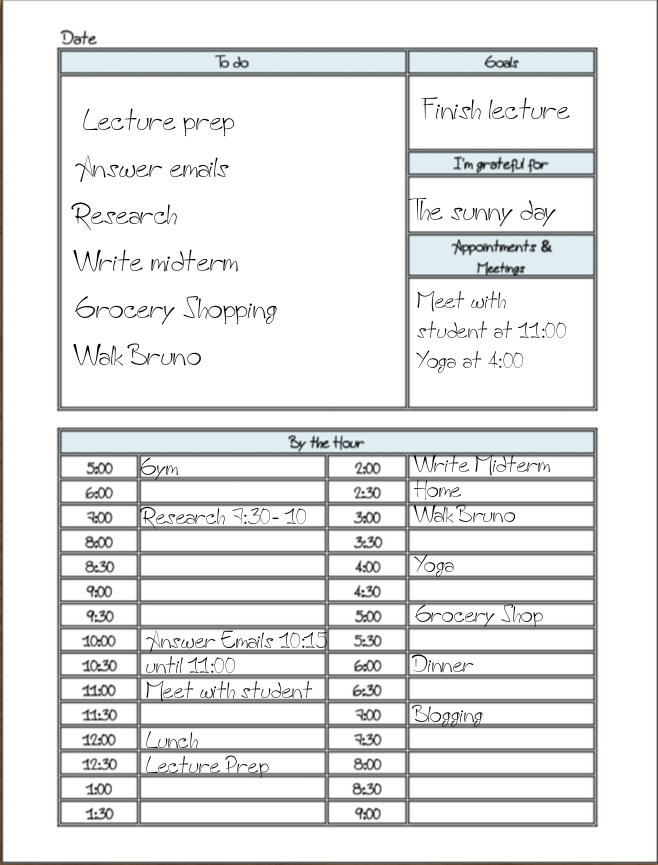
Within each week, there is the option to include daily planners, which helps you time block the day. So in other words, you start big by looking at your month, which you then break down into a weekly list of todos. Then you divide each week’s to-do list into concrete, manageable time blocks each day.
By practicing this approach every week, you successfully stay on top of your tasks. And what’s more, you keep it within your set work hours.
You might notice that the daily planner schedule extends throughout the entire day, not just the typical work hours. I did this for a few reasons. Most importantly, we all have different work schedules. So while my 8 hours go from 7:30-3:30, your schedule might be from 10-6.
The other main reason I included such an expanded window is to ensure we make time for LIFE as well. If you want to get to the gym 3 times a week, then schedule that in! Maybe you want to start practicing yoga; then put it in the planner! If it’s your goal to start reading for fun each night, make sure you include it in your time blocking.
It’s so easy to push aside “me time” when you’re staring at a long to-do list. But if you use your planner and schedule in time for “life,” it’s much harder to overlook.
So if you want to create work-life balance with a planner this year, hop over to my Etsy page. I sell both PDF downloads and actual paper copies of the planner inserts, which I’ll mail directly to your home.
If you choose the PDF option, all you need is a binder and a hole punch and you’re in business. And if you already use some form of disc binder, (the Classic Happy Planner, Mini Happy Planner, the Staples Arc Planner, the Carpe Diem etc.) I have you covered with each size over on Etsy.
And if you’re in the market for a punch, here are a few options. I have the Staples Arc punch, which works great:
So as we dive into 2018, remember the “life” part of work-life balance. Put in your hours, and when you’re done for the day, “let that shit go.” It’s time to play.
And as a bonus for you fantastic Busy Awesome Readers, I’m offering you a free download of my 12-month Habit Tracker! A 24 page document, my habit tracker will keep you working toward all of your goals throughout the year. Click below for your free PDF.

Question:
Do you struggle with work-life balance? How do you manage your time? Do you work a traditional 9-5 or do you set your own hours? Do you use a planner to create work-life balance? Let me know below!


