
Do you ever feel like you can’t get started on a task until the very last minute…and then suddenly your brain switches on? That’s the struggle of ADHD activation, and it has an interesting connection to the Yerkes–Dodson Law.
Psychologists Yerkes and Dodson figured out more than a century ago that our performance follows an inverted-U curve. With too little activation, or what researchers call low arousal, we’re disengaged. With too much, we tip into overwhelm and burnout. But somewhere in the middle is that sweet spot where performance feels steady and sustainable.

Today we’ll explore how this law connects to ADHD, why hyperfocus and burnout can feel like familiar companions, and actionable ways to start finding your sustainable middle point on the curve.
Listen to the episode above or stream it on your favorite podcasting app. Prefer to read? No problem! Keep scrolling for a summary of the key takeaways.
In Episode 326 You Will Discover:
- Why ADHD brains ping-pong between under-activated and overdrive
- How hyperfocus and perfectionism can lead to burnout on the far side of the curve
- Simple tools to support ADHD activation without tipping into overwhelm
Episode 326: ADHD Activation and the Yerkes–Dodson Law (Transcript)
More than a century ago, psychologists Robert Yerkes and John Dodson studied how stimulation affects performance. In 1908, they discovered that our performance actually follows a curve, now known as the Yerkes–Dodson Law.

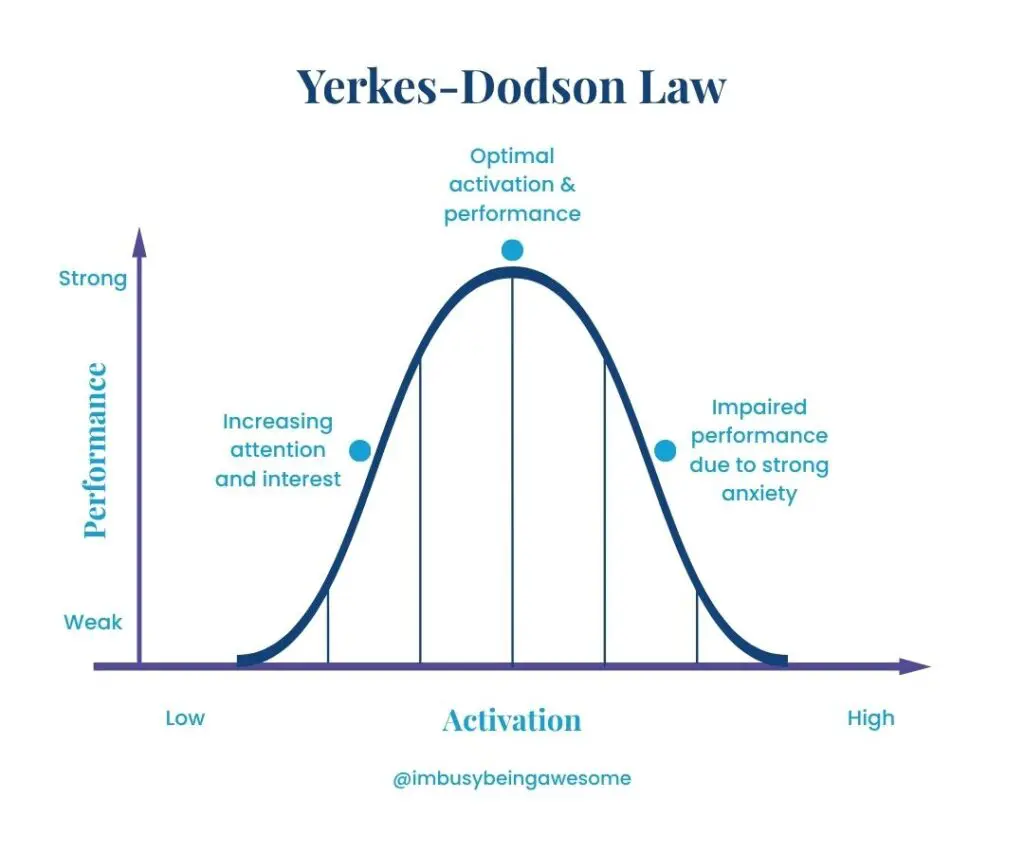
At very low arousal (think low stimulation and low energy,) we don’t perform well. We’re sluggish, disengaged, and tasks feel like pulling teeth.
As arousal increases, so does performance. We feel alert, focused, and motivated. That’s the sweet spot where learning and productivity are at their best.
But there’s also a tipping point. When stress, pressure, or intensity gets too high, performance starts to drop again. We make more mistakes, feel anxious, and often get flooded with overwhelm.
This whole pattern is often described as an inverted-U curve: performance improves with arousal, but only up to a point. After that, too much arousal makes things harder.
Another important piece: the optimal level of arousal depends on task complexity and individual differences.
- Simple or routine tasks often benefit from higher arousal. For example, upbeat music might help you stay engaged while cleaning.
- Complex or detail-heavy tasks tend to require lower arousal. Quiet focus works better for writing a report or balancing finances.
In short: performance rises with arousal until a peak, then falls if arousal climbs too high. And where that sweet spot is depends on both the person and the task.
Why ADHD Brains Struggle With the Middle Zone
While the Yerkes–Dodson Law applies to everyone, many of us with ADHD spend very little time in that “middle” sweet spot of the curve.
On the low-arousal side, ADHD brains often struggle with under-stimulation. Because of differences in dopamine regulation, routine or repetitive tasks can leave us in that flat zone.
You know what I mean, right? Where you know exactly what you need to do, but you can’t get yourself to start. It’s not that you don’t care or that the task doesn’t matter. It’s that your brain isn’t getting enough spark to activate.
And when we feel stuck, we go looking for stimulation. We scroll social media, check email, grab a snack, or say yes to something shiny and new. Other times, we unconsciously create urgency. We wait until the last possible minute to begin, or we add more to our plate to make things feel important enough to get moving.
And that does work for a while. But when we push too far, we overshoot the sweet spot. Suddenly our bodies shift into fight-or-flight. We’re flooded with adrenaline. Our minds race. We hyperfocus, but sometimes on the wrong details. Or we freeze in overwhelm. And eventually, we burn out.
Layered into all of this is the role of time blindness, which many ADHD brains experience. Because we struggle to feel ourselves in time, tasks collapse into just two categories: now or not now. And when “not now” feels far away, we end up waiting until something flips into “now,” usually thanks to a looming deadline or rising pressure. Then boom, we launch up the ADHD arousal curve into overdrive, skipping over that middle ground entirely.
So this creates a ping-pong effect. We default to low arousal, leap into high arousal to compensate, and then crash on the other side.
And here’s the tricky part: many of us with ADHD actually learn to succeed in these extremes. Panic-driven bursts or novelty-fueled energy become the only way we know to get things done. Which makes calm, moderate effort, the true “sweet spot,” feel uncomfortable. It doesn’t feel like enough.
But this is exactly where the Yerkes–Dodson Law helps us. It reminds us that sustainable success isn’t about living at the edges. Sure, we’ll visit those extremes sometimes, but sustainability comes from knowing what our middle looks like and learning how to bring ourselves back there again and again. And while we might need more activation to kick us into gear, we can also take that knowledge to build in more rest time on the other side, too.
Ready to Find Your ADHD Overwhelm Type?
Before we dive deeper, take a moment for my free quiz: What’s Your Overwhelm Type? Designed specifically for ADHD brains, this quick 7-question assessment reveals how overwhelm uniquely affects you and provides personalized strategies to move from stuck to action.
Discover Your ADHD Overwhelm Type!
In less than a minute, you’ll discover your primary overwhelm pattern, understand the obstacles it creates, and get tailored strategies designed for your brain’s natural response style.
Hyperfocus and Burnout at the High Peak
So, let’s talk about what happens when we overshoot the sweet spot and push past the top of the curve. For many of us with ADHD, this is where hyperfocus comes in.
If you’ve ever experienced hyperfocus, you know how powerful it can feel. Suddenly, you are absorbed in what you are doing. Hours can pass without you noticing, distractions fade away, and your brain feels locked in on just one thing.
Sometimes, this is an incredible strength. Hyperfocus can help us dive deep into creative projects, solve problems in unique ways, or push through a big challenge. But here’s the nuance. Hyperfocus does not always mean we are in the sweet spot of the curve. In fact, it can be a sign we have tipped into overdrive. Our brains are so activated that attention narrows completely.
While that intensity can help us in crunch time, like finishing a presentation or responding in an emergency situation, it can also backfire. We might get stuck on the less important details, lose track of priorities, or exhaust ourselves without leaving room for recovery. And when hyperfocus combines with perfectionism, that is when trouble really sets in. Instead of making forward progress, we circle the same detail again and again, trying to get it “just right.” It feels productive, but really, we are sliding down the far side of the curve.
Not surprisingly, this is often where burnout creeps in. When we live at that high end of the curve for too long, riding the waves of hyperfocus fueled by pressure or adrenaline, our brains and bodies simply cannot sustain it. Chronic over-arousal shows up as racing thoughts, anxiety, disrupted sleep, and missed recovery. We get stuck in what I talk about in episode 219 as the ADHD burnout cycle. Over time, the long-term costs add up: exhaustion, lost motivation, harsh self-criticism, and even physical illness.
So yes, hyperfocus can be a powerful tool. If you want to learn strategies to use it more intentionally without burnout, I recommend checking out episode 234, which I’ll link in the show notes. But in the context of the Yerkes–Dodson curve, it is important to remember that just because we are intensely focused does not mean we are in the optimal zone. Sometimes it means we have overshot the curve, and the job is to bring ourselves back toward balance before burnout sets in.
👉 ADHD and hyperfocus research
Reframing Optimal Effort
So with that in mind, I am about to drop a hard truth that my brain still grapples with. It is one of those situations where the intellectual part of my brain knows it is true, but the rest of me cannot quite believe it yet.
Here it is: Optimal performance is not maximum performance.
For so many of us, especially as high achievers, it can feel like the only way to succeed is by giving everything. Doing “enough” means giving 100 percent effort, 100 percent of the time. We push ourselves to the brink in every area of our lives, believing that is where the best performance lives. But in reality, that is not how our brains or bodies work.
The sweet spot is not about maxing out your energy at all costs. The real strategy is about finding sustainable energy. It is about showing up at a level where you feel engaged, alert, and focused without tipping into panic mode or draining yourself dry.
And here is the thing. Performance will naturally ebb and flow. You are not going to sit at the very top of the curve all day long, and that is okay. In fact, it is normal. You are a human, not a robot. Our brains need rest, our bodies need recovery, and our energy levels fluctuate.
Again, a dip does not mean you have failed. It means you are human.
The real skill is not clinging to the peak. It is learning how to shift yourself gently back toward that sweet spot when you notice you have slid too far to one side. If you are feeling distractible or low energy and procrastinating, you might need a little stimulation to nudge yourself up the curve. If you are overstimulated and spinning in stress, you might need to step back, ground yourself, and let your system reset.
When you start practicing this, you will notice that sustainable effort feels very different than overdrive. It is calmer. It is steadier. And most importantly, it is a rhythm you can maintain without burning out.
Practical Tools for Rebalancing ADHD Activation
Signs You’re Off Balance
The first step is awareness and learning to recognize the signs that you are moving into under- or over-arousal. Of course, this will look slightly different for everyone.
- Low arousal may look like procrastination, zoning out, mindless scrolling, or feeling like you just cannot get started.
- High arousal may look like racing thoughts, bouncing between tasks, feeling tense or irritable, or chasing perfection to the point of paralysis.
Nudging Yourself Up
If you are in an under-aroused, low-energy state, try:
- Putting on energizing music to add stimulation
- Moving your body, whether it is a quick walk, some stretches, or dancing around the kitchen
- Setting up body-doubling or co-working, so someone else’s presence gives you a boost
- Stepping outside into the fresh air for a few minutes to refresh your senses
Grounding Yourself Down
If you are in an over-aroused, stressed-out state, try:
- Pausing for a few deep breaths to reset your nervous system (breathe in for 4–6 counts, breathe out for 8 counts)
- Checking in with yourself to see if you have a clear plan before moving forward
- Taking a short micro-break, like stepping outside, grabbing water, or lying down for a couple of minutes
- Doing a quick body scan to notice where you are holding tension and releasing it
Practicing the Middle Zone
Finally, I encourage you to practice getting comfortable with moderate effort. For those of us who are used to living in extremes, the middle space can feel strange or even wrong at first. But with practice, your brain and nervous system learn that this zone is not only safe but also sustainable, especially when we can use strategies to create the needed activation in healthy more supportive ways. A steady pace, while still honoring your energy type, helps you get things done without feeling completely drained. And if you do run hard like us thoroughbreds like to do, you know to build in rest time on the other side to recuperate.
Remember, the goal is not to stay perfectly balanced all the time. It is to notice when you have drifted off center and gently guide yourself back. Over time, these small adjustments add up to a much more sustainable rhythm.
Closing Reflections: Finding Your Sweet Spot
Optimal Is Not Maximum
As we wrap up, remember this: optimal performance is not maximum performance. Success is not about forcing yourself to stay on the peak of the curve or white-knuckling your way through every task.
Redefining Success with ADHD
Real success, the kind that feels good and lasts, comes from finding your personal sweet spot of sustainable effort. This will look different for each person, and that is okay. It is about giving yourself permission to work at a pace that engages you without tipping into panic or burnout.
When You Slip
And when you do slip, because you are human, it does not mean you have failed. It means your brain is doing what brains do. The skill is simply noticing where you are on the curve and making a small shift to move closer to your center again.
Try This Experiment
This week, pay attention to where your brain lands on the curve throughout your day.
- Do you feel flat and under-stimulated? Try music, movement, or accountability to rev yourself up.
- Do you feel amped up and anxious? Try grounding with a pause, a breath, or a smaller next step.
Each time you practice this, you teach your brain that calm, steady effort is possible and that it is enough. Over time, these small adjustments create more space for joy, rest, and the things that matter most.
👉 Ready to apply these Concepts to your life?
Here’s how we can work together:
- 6-Month Private Coaching
- We’re Busy Being Awesome (small group coaching)
- Overwhelm to Action (self-paced course)
Resources From This Episode:
- Episode 219: ADHD Burnout Cycle
- Episode 234: Hyperfocus in Adults with ADHD
- Episode 287: ADHD Energy Type
- My favorite Weighted Eye Mask: Nodpod Gentle Pressure Sleep Mask
- Yerkes–Dodson Law explained
- ADHD and hyperfocus research
More ADHD Resources:
- Discover my favorite ADHD resources
- Learn my Top 10 Tips to Work With Your ADHD Brain
- Access the I’m Busy Being Awesome Planning System
- Get the I’m Busy Being Awesome Podcast Roadmap
- Free course: ADHD Routine Revamp
Leave IBBA A Rating & Review!
If you enjoy the podcast, would you be a rockstar and leave a review? Doing so helps others find the show and spreads these tools to even more people.
- Go to Apple Podcasts
- Click on the I’m Busy Being Awesome podcast
- Scroll down to the bottom of the page, where you see the reviews.
- Simply tap five stars; that’s it!
- Bonus points if you’re willing to leave a few sentences sharing what you enjoy about the podcast or a key takeaway from the episode you just heard. Thanks, friend!


About Paula Engebretson
ADHD COACH | PODCASTER
I spent the first 31 years of my life thinking I just needed to “try harder” while dealing with crushing self-doubt, perfectionism, and imposter syndrome. Then I was diagnosed with ADHD.
Finally understanding the missing puzzle piece, I discovered how to work with my brain, build upon my strengths, and take back control of my life.
Now I help others with ADHD do the same. Learn more.