
If you’ve ever sat down to get something done and walked away an hour later having reorganized your to-do list, opened three new tabs, and somehow started none of the actual work, this episode is for you.
The ADHD Productivity Framework, built around three stages called Plan, Act, and Complete, is the overarching system I use with every coaching client I work with and in my own life as someone with ADHD. After 350 episodes and thousands of hours of coaching, it’s the clearest map I’ve found for understanding why we get stuck and what to do about it.
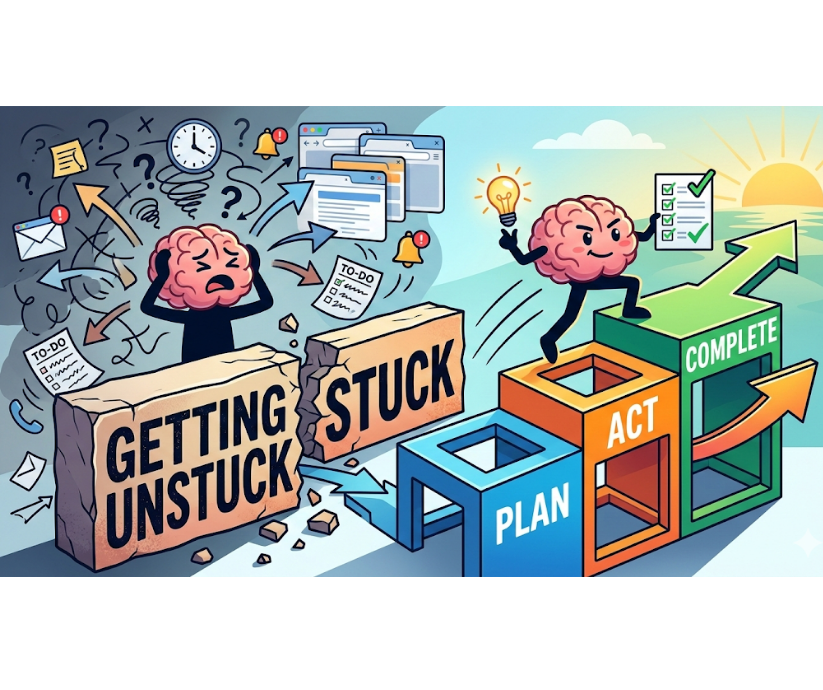
Today, I’m walking you through the full framework from the bird’s-eye view:
- What each stage is
- The specific executive function challenges that make each one hard for ADHD brains
- The specific tools and strategies that actually help.
Whether you’re someone who plans beautifully but can’t seem to start, someone who starts strong but never quite finishes, or someone who spins in overwhelm before any of that, this framework gives you a way to identify exactly where the friction is and what to reach for next.
Listen to the episode below or stream it on your favorite podcasting app. Prefer to read? Keep scrolling for a full summary of key takeaways.
In Episode 350 we’re exploring:
- What the ADHD Productivity Framework (Plan, Act, Complete) is and why it works for neurodivergent brains
- How overwhelm and burnout show up differently, and what each one is signaling
- The specific executive function challenges behind each stage of the framework
- How to design your week around your actual rhythm
Episode 350: The ADHD Productivity Framework: A Guide to Plan, Act, and Complete for the ADHD Brain (Transcript)
After 350 episodes and thousands of hours of coaching fellow ADHD brains, one framework keeps rising to the surface as the clearest way to understand how we get things done sustainably. That framework is Plan, Act, Complete, and it forms the foundation of the ADHD Productivity Framework I use with every client I work with and in my own life.
This post walks you through the full framework so that the next time you feel stuck, spinning, or like you’re working hard but getting nowhere, you have a map. You’ll know where you are, and you’ll know exactly what to reach for next.
A Quick Introduction (For Those Who Are New Here)
I’m Paula. I’m an ADHD coach, and I work with high-performing ADHD brains who probably cringe at that label. People who, on paper, have it together, but who are, behind the scenes, working at least ten times harder than everyone around them just to keep up. People who have been told they can’t possibly have ADHD, because “look at everything you’ve accomplished.”
I know that story because it was mine, too.
For the first 31 years of my life, I was undiagnosed. I worked my way through grad school, earned my doctorate, built a career as a tenure-track professor, and I was exhausted and burned out in a way I couldn’t quite explain. I tried every planner, every productivity system, every organizational hack I could find, and nothing stuck.
When I finally got my diagnosis at 31, everything started to make sense. And eventually, that understanding led me here, to this podcast, to coaching, and to building strategies that actually work with our ADHD brains.
In six-plus years and 350 episodes of this podcast, if there is one thing I keep coming back to, it’s this: getting things done sustainably with an ADHD brain comes down to three stages, built on top of a foundation. Those three stages are Plan, Act, and Complete.
Why ADHD Brains Need a Different Kind of Productivity Framework
The dominant message in most productivity culture is simple: do more, move faster, push harder, stay consistent. For ADHD brains, that formula tends to create two very specific traps that come up again and again, both in my own life and in thousands of hours of coaching. The first trap is overwhelm. The second is burnout.
ADHD Overwhelm vs. Burnout: Two Different Signals
Overwhelm tends to arrive before we’ve even taken action. It shows up when we sit down to work and suddenly every task seems equally urgent and important. Executive function maxes out, the brain is trying to sort through too many open loops with no clear starting point, and it freezes. The result is that particular stuck-spinning feeling: reorganizing the to-do list, opening a fresh note, rewriting the plan, doing the easiest tasks on the list just to feel like we’re doing something, without actually moving the needle on what matters most.
Analysis paralysis is real, and for ADHD brains especially, it can eat up an enormous amount of time and energy without us even realizing it. If you find yourself often spinning when trying to decide where to begin, Episode 146 on the ten prioritization traps is a useful place to dig into that pattern more.
Burnout has a different texture. It tends to show up after we’ve been pushing through for too long. Many of us are high performers. We care. We want to follow through. So when something needs to get done and the pressure gets high enough, the default is to white-knuckle past the resistance, the fatigue, the low-energy day, and just make it happen.
In the short term, that sometimes works. But ADHD brains often naturally run in intense bursts of focus and genuinely need recovery time on the other side. Most of us keep skipping that recovery time, over and over, until we eventually hit that wall of deep exhaustion where a few nights of sleep or low power mode no longer helps.
Both of these experiences, the freeze of overwhelm and the crash of burnout, are your brain sending you a signal. Think of them like a check engine light. They’re telling you that the current system is past capacity and needs some support. The most useful thing we can do when that light comes on is pause, get curious, and ask: which part of the system needs support right now?
That’s the question the Plan, Act, Complete framework is built to answer.
The ADHD Productivity Framework: Plan, Act, Complete
The core framework has three stages: Plan, Act, and Complete. Each one has its own specific set of challenges rooted in executive function, and its own set of supports that actually work for ADHD brains.
Think of it as a bird’s-eye map. Whenever you feel stuck, you can zoom out to this map, orient yourself, and identify exactly where the friction is coming from. The clarifying question to carry with you is: In which stage am I feeling stuck right now? Plan, Act, or Complete?
Once you know where the friction lives, you know where to focus your energy and which supports your brain actually needs.
Stage One: Plan
Planning is where it all starts, and for many ADHD brains, it comes with a complicated history. There’s often real enthusiasm for the idea of planning. A fresh notebook. A clean weekly spread. A satisfying color-coded calendar. And then real life shows up, the plan falls apart by Tuesday, and we often internalize that as evidence that we’re just bad at planning.
The reality is that most planning systems were designed for neurotypical brains. They assume steady energy, linear focus, and executive functions that are reliably on. Because this isn’t written on the planner or noted in the app description, we don’t know. So we try to force ourselves into these approaches, and when we find ourselves constantly fighting the rigid structure, we blame ourselves. That’s not where the problem is.
Planning is genuinely challenging for the majority of ADHD brains because it relies so heavily on executive functions that aren’t always reliable. A few of the most common culprits:
ADHD time blindness is one of the most significant obstacles. Many ADHD brains experience time in two zones: now and not now. Anything that isn’t happening immediately exists in a kind of abstract, fuzzy future that’s genuinely hard to plan around, because it doesn’t feel real or pressing yet. It’s not in the “now.”
Working memory challenges mean we’re trying to hold all of our tasks, commitments, and priorities in our heads simultaneously, and our working memory simply isn’t built to carry that load reliably.
Prioritization difficulties compound this further. When everything on the list seems equally important, the brain often can’t choose what to actually schedule, and we freeze, spin, or find ourselves procrastiworking instead.
Planning for an ADHD brain means creating plans designed to work with these exact challenges. Planning is about creating scaffolding. Think about the scaffolding on a building: those extra supports on the outside that hold things up. We want to provide that extra scaffolding when we’re planning, that extra support so our brains feel clarity and direction, without being locked into something so rigid that one unexpected interruption sends the whole thing crashing down.
Here are a few starting points if you’re feeling stuck in the planning stage:
Get everything out of your head first. A thought download, a brain dump, whatever you want to call it: the act of getting every open loop off your mental plate and onto paper is one of the most relieving things you can do for your brain. Once it’s out, you can look at it with perspective instead of feeling the weight of it spinning around in your working memory. As explored in the Zeigarnik Effect episode, the weight of all those open loops can absolutely stop us in our tracks. So begin planning by getting everything out of your head and onto paper.
Narrow your focus to one to three priorities. From there, pick the most important thing to focus on. A useful focusing question: If only one thing got meaningful attention today, what would most reduce stress or create momentum? Or: If I completed just one thing from this list, what would feel most like a win?
If your brain truly cannot decide because everything feels equally urgent, just pick the thing at the top of the list. If everything is genuinely the same level of importance, the order doesn’t matter, so start with whatever feels easiest. Then pick the next one or two priorities based on what supports that top priority.
For those who prefer a looser level of structure, you can stop there. Just start with that one priority. For those who need more support with time blindness, that’s when scheduling becomes valuable: carving out the actual space in your day to do the work.
Schedule Doing Dates, not just due dates. Doing Dates are different from due dates. A Doing Date is a dedicated block of time where you’re actually sitting down to do the work. It bridges the gap between the abstract “I’ll get to it” and actually getting there, which is exactly what time blindness makes so difficult without that concrete structure.
Stage Two: Act
You have a plan. Now comes the part where you actually do the thing, and this is where procrastination loves to show up and make itself very comfortable.
Many of us have said some version of this: I know what I need to do. I’m just not doing it. And when that’s where you are, there’s usually something more specific going on beneath the surface than simple avoidance.
Task initiation for ADHD brains is genuinely, neurologically hard. Getting started isn’t one single action. As covered in Episode 344 on task initiation, it involves a whole sequence of executive functions all needing to fire in the right order: shifting attention from what you were just doing, activating toward the new task, managing the emotions that come up around it, and sustaining enough focus to actually begin. Any one of those steps can become the place where things stall.
Sometimes the barrier is emotional: dread, anxiety, the certainty that the task is going to be harder or more miserable than it actually is. Sometimes it’s perfectionism showing up at the front end, where we can’t begin until conditions are exactly right, until we know the perfect approach, until we’ve done enough research or created the perfect plan. Sometimes the task just feels so big and undefined that our brain genuinely can’t find a place to grab onto it.
Here are a few supports for the Act stage:
Practice the pause before you start. This is where we intentionally step out of reactive mode before we begin. We take a breath, assess what’s happening, and do a quick thought download about what feels especially hard about getting started. One approach: write out all the reasons you don’t want to do the thing. Let your brain have the toddler tantrum without judgment. And once your brain has had its say and you’ve named the specific obstacles, gently question whether they hold up. Is it really too hard to make that phone call? Most of the reasons don’t hold up once they’re named, and naming them takes away a lot of their power.
This is also where the friction-reduction strategies from the 20-Second Rule episode come in especially handy: think about what might make it easier to start, and reduce that friction as much as possible before you begin.
Zoom in on the task. When a task feels impossible to start, it’s almost always because the version of it in your head is too big. So zoom in. Break it down into smaller and smaller pieces until you find a step so approachable that your brain stops pushing back. Rather than “write the report,” maybe it’s just “open the document and read what you’ve already written.” Sometimes that’s genuinely all we need to get ourselves into flow.
Use the Next Five Reset when the day goes sideways. For the moments when you didn’t stick to the plan perfectly and your brain wants to go all-or-nothing: instead of waiting for a fresh start tomorrow or Monday, find the next five-minute mark on the clock. If it’s 2:42, reset at 2:45. If it’s 3:07, do a fresh start at 3:10 or 3:15. Give yourself those couple of minutes to feel whatever frustration is there, and then begin again from right there. The day is never actually ruined. There’s always a next moment to come back to.
Stage Three: Complete
You planned. You got started. And now you want to finish. If you’ve ever found yourself 80% done with something and completely stalled, you already know this stage has its own particular flavor of challenge.
There are real executive function reasons why completion tends to be hard for ADHD brains. One is that we’re wired for novelty and stimulation. Our brains generate energy and engagement around new problems, and by the time a project has moved out of the interesting, challenging phase and into the detail-oriented finish work, the dopamine has dropped. The work that’s left, the administrative tidying, the final edits, the last few details, is often exactly the kind of low-stimulation task our brains find hardest to sustain.
There’s also the last 5% phenomenon: that last stretch of a project that somehow keeps expanding. We can see the finish line, we’re convinced we’re almost done, and then we realize there are still seventeen small things that need to happen. This happens often because our sense of time and task scope is genuinely distorted by time blindness and working memory challenges. We underestimate what’s left because we can’t fully hold the whole picture in our heads at once.
And then back-end perfectionism tends to show up in full force right at the end, because finishing means putting the thing into the world where other people will see it. Imposter syndrome, fear of judgment, the urge to keep polishing: all of it tends to cluster right here at the completion stage, right when we need momentum the most.
Here are a few supports for the Complete stage:
Rebuild your commitment and momentum on purpose. Before you try to push through the last stretch, reconnect with the why. When our why gets fuzzy, our brains have an easier time treating the work as optional. So bring it back into focus. Ask: What do I want this to make possible? Who benefits if I finish this? (Future you counts.) What problem does this solve, or what stress does it prevent later? If I quit right now, what would Future Me have to clean up? Write one sentence you can come back to when the dopamine drops.
Create a clear definition of done. Many of us never actually give ourselves a definition of done, so when we have a tendency toward perfectionism, we just keep moving the bar. We keep tweaking and adjusting because we don’t actually know what we’re working toward. Write one sentence before you start that describes what a finished, good-enough version looks like. That gives your brain a clear stopping point. As the saying goes, don’t let perfect be the enemy of good. The version that exists and gets shared will always do more good than the version that stays on your hard drive forever waiting to be perfect.
Working With Your Natural Energy Rhythms
The Plan, Act, Complete framework gives you the structure. Learning to use it in a way that honors your natural energy rhythms is what makes it sustainable over time, rather than just another system that works for a few weeks and then fades out.
Traditional productivity culture tends to hold up one model of energy: steady, consistent, linear output, the same amount of focused work every day, reliably. Some people genuinely thrive with that kind of rhythm. I call them workhorses. They do their best work through predictability and consistency. A little bit every day: researching and writing for two hours each morning until the end of the month, when they have a complete draft. Tidying one room during lunch each weekday. If that’s authentically how your brain operates, that’s a real strength worth leaning into.
Many ADHD brains, especially when it comes to projects and focused work, perform best as thoroughbreds. We work in intense bursts of focus and then need real recovery time on the other side. We can sprint with extraordinary concentration when we’re in the zone, for hours, even days, and that capacity for deep, hyperfocused work is genuinely powerful.
The part that tends to trip us up is skipping the recovery. We sprint hard, push through the fatigue, sprint again, and eventually hit that wall we talked about at the beginning of this post. We’re trying to run at a thoroughbred pace with the rhythm of a workhorse schedule, and that’s what creates burnout.
Building intentional recovery into your week, actual white space, lighter days, time to recharge, is what makes the next sprint possible. For thoroughbred brains, recovery time belongs in the plan just as much as the deep work does. When I’m working with a client and I see they’re planning a sprint, I ask: where is your recovery time? Have we literally carved out space for it? If not, we’re setting ourselves up for burnout.
It’s also worth noting that you might not be fully one or the other. For example, while I primarily align with the thoroughbred for creative work, I’m definitely more of a workhorse when it comes to exercise. I’m not preparing for a marathon or training for a triathlon. I just want 30 minutes every day, in and out. That’s enough. But when it comes to content creation, projects, and making things, that’s where I drop into thoroughbred mode.
Maybe you’re similar: more of a workhorse for a few daily habits and routines, and a thoroughbred for big creative projects. Or maybe your energy style shifts depending on the season of life you’re in. The useful thing is just to start paying attention to your actual patterns and design your week around what you genuinely observe, rather than what you think you “should” be able to sustain.
The Iteration Mindset: Treating Your System as a Working Draft
Alongside all of this, I want to bring in what I call the iteration mindset, because I think it’s essential to how we hold this whole framework over time.
Whatever system you build from Plan, Act, Complete: your planning approach, your weekly structure, the way you move through all three stages, treat it as a working draft. You’re gathering data about your actual brain, your actual energy, your actual life. What worked this week? What created friction? What needs to shift? Each round of that cycle gets you a little closer to a structure that genuinely fits.
👉 Ready to apply these Concepts to your life?
Here’s how we can work together:
- 6-Month Private Coaching
- We’re Busy Being Awesome (small group coaching)
- Overwhelm to Action (self-paced course)
This is how sustainable systems get built. The plan that serves you six months from now will probably look meaningfully different from what you’re working with today. You’re designing something that grows with you, and that’s a very different experience from forcing yourself into a system that expects you to change yourself to make it fit.
Bringing It All Together
The Plan, Act, Complete framework is your big-picture map. Whenever you find yourself spinning, frozen, avoiding, or just feeling like nothing is working, come back to this one question: in which stage am I feeling stuck right now?
If you have a plan but can’t seem to get moving on it, that’s a task initiation challenge, and that’s where your Act toolkit comes in. If you’re 80% done with something that keeps not getting finished, that’s a completion challenge, and there are specific supports for that too. You don’t have to figure out everything at once. You just need to know where you are, and then take the next step from there.
Ready to Find Your Starting Point?
Wherever you’re feeling stuck right now, Plan, Act, or Complete, there’s a specific set of supports designed for exactly that challenge. A great next step is grabbing the free I’m Busy Being Awesome Podcast Roadmap, which organizes the full episode archive by sticking point so you can navigate straight to what’s most relevant for where you are right now.
Discover Your ADHD Overwhelm Type!
In less than a minute, you’ll discover your primary overwhelm pattern, understand the obstacles it creates, and get tailored strategies designed for your brain’s natural response style.
Resources From This Episode:
- Episode 146: 10 Prioritization Traps That Keep The ADHD Brain Stuck
- Episode 219: What Is The ADHD Burnout Cycle? 6 Different Stages
- Episode 220: 7 Steps To Recover From ADHD Burnout Using ‘Low Power Mode’
- Episode 319: 5 Ways To Stay Motivated After The Dopamine Drop
- Episode 327: ADHD Mental Fatigue or Resistance? How to Know Which One You’re Experiencing
- Episode 338: I Never Finish Anything! ADHD & The Last 5%
- Episode 341: The Zeigarnik Effect & ADHD: How to Stop Spinning on Unfinished Tasks
- Episode 344: Why “Just Start” Never Works: ADHD Task Initiation Explained
More ADHD Resources:
- Discover my favorite ADHD resources
- Learn my Top 10 Tips to Work With Your ADHD Brain
- Access the I’m Busy Being Awesome Planning System
- Get the I’m Busy Being Awesome Podcast Roadmap
- Free course: ADHD Routine Revamp
Leave IBBA A Rating & Review!
If you enjoy the podcast, would you be a rockstar and leave a review? Doing so helps others find the show and spreads these tools to even more people.
- Go to Apple Podcasts
- Click on the I’m Busy Being Awesome podcast
- Scroll down to the bottom of the page, where you see the reviews.
- Simply tap five stars; that’s it!
- Bonus points if you’re willing to leave a few sentences sharing what you enjoy about the podcast or a key takeaway from the episode you just heard. Thanks, friend!


About Paula Engebretson
ADHD COACH | PODCASTER
I spent the first 31 years of my life thinking I just needed to “try harder” while dealing with crushing self-doubt, perfectionism, and imposter syndrome. Then I was diagnosed with ADHD.
Finally understanding the missing puzzle piece, I discovered how to work with my brain, build upon my strengths, and take back control of my life.
Now I help others with ADHD do the same. Learn more.