
Have you ever looked at a pattern you thought you’d “fixed” — maybe you’ve fallen back into overcommitting, or the all-or-nothing thinking has crept back in, or you’ve found yourself avoiding the very thing you spent weeks building a habit around — and your ADHD brain quietly offers this thought:
“Here we go again. After all this. I’m right back where I started.”
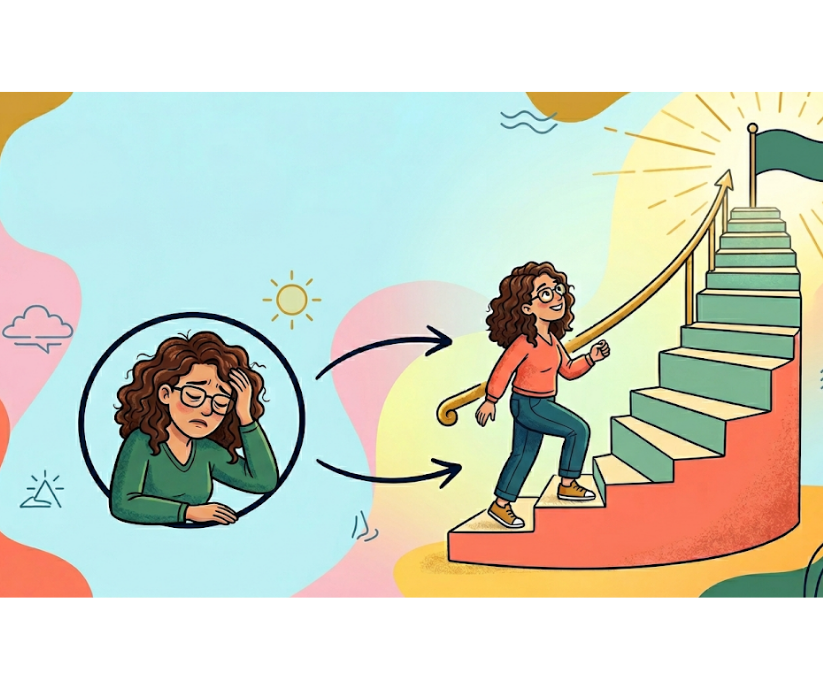
That moment carries a particular kind of weight. It holds both the frustration of right now and the accumulated frustration of every other time you’ve felt this way before.
If that sounds familiar, you’re not alone, and more importantly, you’re not actually back at square one.
In Episode 352 of the I’m Busy Being Awesome podcast, I want to offer you a completely different way of understanding what’s happening in those moments. And I think by the end of this, that “here we go again” feeling might mean something very different to you.
In Episode 352, we’re exploring:
- Why ADHD brains feel like they keep returning to the same patterns (and why you’re not actually back at square one)
- The Spiral Staircase Model of growth and what it really means for your ADHD journey
- Three reflection questions to help you recognize and learn from the progress you’ve made
Listen to the episode above or stream it on your favorite podcasting app. Prefer to read? No problem! Keep scrolling for a summary of key takeaways.
Episode 352: Always Starting Over with ADHD? The Spiral Staircase of Growth (Transcript)
Why ADHD Brains Feel Like They Keep Falling Back Into Old Patterns
Most of us have absorbed a very specific picture of what growth is supposed to look like: you identify the problem, you find a solution, you implement it, and you move forward in a clean, linear, upward trajectory.
But that picture rarely matches the lived experience of an ADHD brain.
For ADHD brains, growth is iterative and seasonal. It involves a lot of circling back, learning, adjusting, tweaking, and trying again. When we measure our real progress against that straight upward line, we come up short almost every time, especially when we’re doing something new.
So when we find ourselves back in familiar territory, encountering the same perfectionism spiral, the same overcommitting, the same avoidance loops, our brains jump to what feels like the only logical conclusion: something went wrong, something isn’t working, and we blew it again.
A reframe like the one I want to offer today can change all of that.
The Spiral Staircase Model of ADHD Growth
My coach Kelly introduced me to a different image back in 2020, and it completely changed how I understand progress. She described growth not as a straight line upward, but as a spiral staircase.
Here’s what that means: you’re always climbing, and you’re also always coming back around to familiar territory. Similar themes, similar patterns, similar obstacles you thought you’d left behind.
From the inside of that spiral, it feels disorienting. You look around and the scenery seems familiar. Your brain concludes you must be back where you started. That’s when the frustration and discouragement move in.
Here’s what’s actually true: you’re higher up on the staircase than you realize. The territory might look the same because it is the same territory, but your relationship to it has changed. Your tools have changed. Your awareness has changed. The view from where you’re standing now is genuinely different from the view you had last time you were here, even if the surroundings look similar.
When Kelly first offered me that image of the spiral staircase, it really changed something. Because it gave me a way to make sense of the moments that had always seemed like failure — the times I’d find myself back in perfectionism, or back in overcommitting, and think: “Why am I still dealing with this?” The answer, it turns out, is that this is what growth looks like. You come back around, but just a little bit different. That’s part of the design.
I want to make this concrete, because I think it lands differently when you can see it in an actual person’s experience. And I’ll start with myself, because it’s important to say that this isn’t something I’ve graduated from. I still come back around to the spiral staircases of perfectionism and overcommitting, particularly when I’m doing something new — a new launch, a new format, something I haven’t tried before. That’s often when those old patterns sense an opening.
But here’s what’s different now compared to five years ago, or three years ago, or even six months ago. Over the years, I’ve learned to recognize the patterns so much faster. I know what they feel like before they’ve fully taken hold. I know which thoughts tend to show up first, and I know what it means when I start hearing them. And each time around, I catch them that much sooner. I’m able to pivot, or bring in my supports faster, so that I don’t get stuck in the trap of perfectionism for days or weeks or months, but instead minutes or hours. Or I notice there are too many things on my calendar and I cancel appointments, adjust deadlines, or change my plan — rather than forcing myself to just push through and drive straight back into burnout.
That’s the staircase working for me. And it shows up the same way for the people I coach.
What ADHD All-or-Nothing Thinking Looks Like on the Staircase
One of my clients used to slip into all-or-nothing thinking whenever he missed a day on a habit he was building. His brain would immediately go to: “I blew it. Why do I even bother? I just can’t stick to anything.”
And when those thoughts flew in, his whole system came down. Not just the one habit, but everything. One missed day would trigger a cascade where all the routines and habits he’d built started to crumble, because his brain had concluded there was no point in trying.
This is one of the most common patterns I see in ADHD brains.
As we worked together, what shifted over time was his ability to catch that thinking faster. He started noticing the familiar thoughts looping through his mind and recognizing them for what they were. He built a pause between missing a habit and the impulse to throw it all out the window. (If you’ve ever struggled to get back on track after a disruption, this pattern will feel very familiar.) And in that pause, he started finding something between the black and the white.
The inner voice shifted from “I blew it, I failed again” to something more like: “Hold on. I missed one day. That’s what happened. I can start again right now.” That shift is exactly what growth on the staircase looks like.
Does he still come back around to all-or-nothing thinking sometimes? Sure. Especially when establishing a new routine. But now, instead of it taking a whole week to recover, it might take an afternoon. Instead of his whole system coming down, maybe one thing slips and the rest holds. Each time around, he’s moving higher on the staircase, building greater perspective and faster access to the supports he needs.
Why ADHD Progress Is So Hard to See
Our brains are genuinely good at cataloging the times we’ve fallen back into a pattern. They keep careful records of every slip, every missed day, every time the old thinking won out. Recognizing progress is a much quieter process.
Growth on a spiral staircase tends to show up in small, easy-to-miss ways: the argument that resolved in an afternoon because you gave yourself space to regulate before reconnecting; the habit that slipped for a week instead of a month, and you knew exactly what supports to put in place to get back to it; the moment you caught yourself in the middle of overcommitting and paused before saying yes.
These moments pass without fanfare. And because we’re waiting for dramatic, permanent, linear progress, the real kind slips by unnoticed.
This is one of the reasons reflection matters so much for ADHD brains, not as a productivity tactic, but as a genuine act of fairness toward yourself. It’s also one of the core skills we build in redefining what ADHD consistency really looks like. When we only notice the times we came back around to familiar territory, without also noticing that we’re handling it differently than we used to, we’re only getting half the picture. And it tends to be the half that feels the worst.
3 Questions to Measure Your Real ADHD Progress
If you want to start seeing your growth on the spiral staircase, sit with these three questions. (If you’re driving, tuck them away and come back to them later.)
1. Where is a struggle that used to take you down that barely registers now?
It might be something you’ve almost forgotten was ever hard because you’ve become so practiced at navigating it.
Maybe you used to forget your medication most days. Now you put the bottle in your coffee mug the night before, and it’s simply not a problem anymore. Maybe you used to spend 10 minutes looking for your phone before leaving the house. Now you have one spot where it always goes.
What’s something that used to feel so hard, but now you barely register it?
2. What do you catch yourself doing now that you never used to catch?
This could be a thought pattern, a behavior, an impulse, something that used to run quietly in the background that you now notice, sometimes even before it’s fully taken hold. This kind of noticing is actually one of the four phases of self-awareness with ADHD — and it’s a skill that grows with practice.
Maybe you start scrolling your phone and realize more quickly: “Oh, I’m avoiding answering that email.” In the past, you wouldn’t have registered it at all, and you’d have spent the next hour scrolling instead.
What’s something you catch yourself doing now that you never used to catch?
3. Where do you recover faster than you used to?
Where does the spiral bring you back around to familiar territory, and you find your footing again in hours instead of days, or days instead of weeks?
Where are you recovering faster than you used to?
These questions ask your brain to do something that takes real practice: looking backward to find evidence of your own progress. And I want to acknowledge that this can feel genuinely uncomfortable when forward momentum seems so much more pressing. There’s a reason our brains resist it — looking back requires slowing down, and slowing down can feel counterintuitive when you’re trying to build something.
But what I’ve found, both in my own experience and in watching my clients do this work, is that the evidence is almost always there. The staircase is clear. We’re often several layers up — we just haven’t been looking for it. If you want a deeper framework for this kind of reflection, shifting from a fixed to a growth mindset with ADHD is a great place to continue.
The “Here We Go Again” Moment Is Actually Evidence of Growth
I want to come back to where we started — that “here we go again” moment. The weight of it. The accumulated frustration of finding yourself somewhere familiar that you thought you’d already moved past.
What I want you to carry from this conversation is this: the next time that familiar struggle shows up — and it will, because that’s how growth works — you can pause and ask yourself: Where am I on the staircase right now? What can I learn from this new height?
That moment of recognition, when you see the familiar pattern, when you catch the familiar thought before it fully takes hold, is the staircase working. You couldn’t always see it coming. The fact that you can now is evidence that your awareness has grown. And that awareness is what changes everything about what happens next.
The “here we go again” feeling, it turns out, isn’t a sign that you’ve failed or fallen backward. It’s a sign that you’ve climbed high enough to recognize the view.
Want Support Seeing Your Own ADHD Growth?
Noticing your own growth can feel genuinely hard to do in isolation. It’s so much easier when others can reflect it back to you, when someone who was there two months ago says: “Hold on, do you remember how hard that was when you started? Look at how you handled it this time.”
That’s exactly what happens inside We’re Busy Being Awesome, my small group coaching program for ADHD brains. We meet weekly, do real coaching, and build strategies designed for YOUR brain, in a supportive container where spiral staircase growth gets witnessed and celebrated instead of overlooked.
Enrollment for the summer cohort is opening soon. Get your name on the waitlist here.
And if you want to start right now, take my free quiz to discover your ADHD Overwhelm Type and find out the unique way overwhelm shows up for your brain and the powerful first steps to move from stuck into action.
Discover Your ADHD Overwhelm Type!
In less than a minute, you’ll discover your primary overwhelm pattern, understand the obstacles it creates, and get tailored strategies designed for your brain’s natural response style.
Work With Me:
- Join We’re Busy Being Awesome (group coaching)
- Learn more about private coaching here
- Discover Your ADHD Overwhelm Type – Free Quiz!
- Enroll in Overwhelm to Action – step by step course for ADHD Brains
More ADHD Resources:
- Discover my favorite ADHD resources
- Learn my Top 10 Tips to Work With Your ADHD Brain
- Access the I’m Busy Being Awesome Planning System
- Get the I’m Busy Being Awesome Podcast Roadmap
- Free course: ADHD Routine Revamp
Leave IBBA A Rating & Review!
If you enjoy the podcast, would you be a rockstar and leave a review? Doing so helps others find the show and spreads these tools to even more people.
- Go to Apple Podcasts
- Click on the I’m Busy Being Awesome podcast
- Scroll down to the bottom of the page, where you see the reviews.
- Simply tap five stars; that’s it!
- Bonus points if you’re willing to leave a few sentences sharing what you enjoy about the podcast or a key takeaway from the episode you just heard. Thanks, friend!


About Paula Engebretson
ADHD COACH | PODCASTER
I spent the first 31 years of my life thinking I just needed to “try harder” while dealing with crushing self-doubt, perfectionism, and imposter syndrome. Then I was diagnosed with ADHD.
Finally understanding the missing puzzle piece, I discovered how to work with my brain, build upon my strengths, and take back control of my life.
Now I help others with ADHD do the same. Learn more.