

Today we’re celebrating 200 episodes of the podcast. Wow!
When I started the I’m Busy Being Awesome podcast back in 2019, I had no idea what to expect… and because of that, my brain loved spinning in doubt.
- Will I like doing this?
- What if nobody listens? (What if people DO listen?!)
- Will I even be able to stick with it?
- What if it’s too hard?
Now, nearly four years and 200 episodes later, I can say with certainty that I do like it (love it, actually), people will listen, I can stick with it, and it is hard…but in a good way.
Podcasting is a challenge that stretches me out of my comfort zone while fostering growth.
And the best part of all is hearing from listeners in my inbox, on Instagram, and through podcast reviews.
Discovering how the podcast has helped fellow ADHD brains better understand themselves, develop greater self-acceptance, and learn how to work with their ADHD, makes every late night, every technical glitch, and every moment of self-doubt worth it.
It’s because of you that I keep showing up each week.
It’s because of you that I keep sharing stories, ideas, and insights on how to compassionately navigate your ADHD while doing the things that matter most to you.
So thank you.
Thank you for being here, thank you for listening and for your continued support.
You’re Busy Being Awesome.
To mark the 200th episode, I decided to celebrate by creating a highlight reel of listener favorites.
As you listen this week, I invite you to reflect on and celebrate your own growth since the first time you tuned into the podcast.
Because you deserve it.
You can listen to the episode above or stream it on your favorite podcasting app here.
Prefer to read? No problem! Keep scrolling for the entire podcast transcript.
In Episode #200, You Will Hear
- Paula’s reflection on the journey of creating 200 episodes
- The inspiration for episode 200 specifically
- A highlight reel of listener favorites and key takeaways
Leave IBBA A Rating & Review!
If you enjoy the podcast, would you be a rockstar and leave a review? Doing so helps others find the show and spreads these tools to even more people.
- Go to Apple Podcasts
- Click on the I’m Busy Being Awesome podcast
- Scroll down to the bottom of the page, where you see the reviews.
- Simply tap five stars; that’s it!
- Bonus points if you’re willing to leave a few sentences sharing what you enjoy about the podcast or a key takeaway from the episode you just heard. Thanks, friend!
Join Our Group Coaching Program – We’re Busy Being Awesome!
Add your name to the waitlist!
A four-month small, supportive group coaching program for adults with ADHD and ADHD tendencies.
To learn more check out We’re Busy Being Awesome. Are you ready?
Episode #200: Celebrating 200 – Key Lessons and Listener Favorites (Transcript)
Hey, everybody. Welcome to celebrating 200 episodes of te I’m Busy Being Awesome podcast. That’s pretty fun.
When I started this podcast way back in 2019, I had no idea what to expect. I knew I wanted to start a podcast because, as an ADHDer, it’s one of the best ways for my brain to learn and process information.
Since I love sharing simple ways to support your brain through both actionable strategies and mindset and reflection, I thought using a podcast as my platform would be the most effective for my listeners, too.
Now we are 200 episodes in – almost 4 full years of podcasting without missing a week – and I am absolutely honored and grateful that you’re here spending this time with me.
I keep showing up and sharing – even when it’s hard, even when my executive functions don’t show up for work – because of you. Because I know you’re doing the same.
Your support and the way you share this podcast with your friends and colleagues and on your social media feeds – the messages I get in my DMs and my inbox letting me know how this podcast is helping you work with your brain mean everything.
It’s what keeps this podcast churning, and I’m deeply grateful for you.
As always, thank you for being here.
Celebrating 200 Episodes!
To mark our 200th episode, I knew I wanted to do something a little different. And one of my brilliant clients, who always has the most fun ideas, suggested I put together a “highlight reel” of sorts to showcase the most popular episodes. And I thought, what a fantastic idea!
So, I dove into the podcast platform to see which episodes were most frequently downloaded, and I compiled the top eight into this episode.
As a side note, I started with 10, but the episode was getting quite long, so I decided to trim it back to keep it around the 30-minute mark.
These eight episodes span a wide range of topics from time management and scheduling, to sticking with routines, to prioritization, perfectionism, resourcefulness, and navigating failure. And doing all of this while navigating an ADHD brain or ADHD tendencies.
They represent some of our communities favorites, and I’m excited to revisit them with you.
As we journey through this episode, I encourage you to reflect on your own personal growth and progress since you first tuned in. Celebrate the moments of success and look with compassion and curiosity at the stumbling blocks to see how they’re also beautiful areas for growth.
Before we dive in…
I want to remind you about my free training that you do not want to miss. It’s scheduled for June 6th, 7th, and 8th – and we are taking a deep dive into the topic of overwhelm.
Because let’s be honest – ADHD overwhelm is very real and it can keep us very stuck.
In this three-day training, you’ll learn how to:
- Take care of yourself when your brain is past capacity and stuck in the spin cycle so that you can slow things down
- Create clarity around what’s most important, and start making that progress forward that you want to make.
- Learn some powerful tools and concepts AND you’ll have the chance to raise your hand and get coached by me live.
I’m telling you, it’s going to be so much fun. So if you ever navigate overwhelm – which, hello! if you have ADHD you absolutely will – you don’t want to miss it.
And with that, I invite you to sit back and relax as we dive into this highlight reel together.
Episode #76: How Many Goals Should I Set?

Imagine lining up five soccer balls at the end of the soccer field with the goal of getting all five to the other side. What would be the fastest way to get there?
Well, you could absolutely keep kicking all five, running back and forth between each ball as you dash all over the field. Or, you could stick with one ball, kick it all the way down the field with focused attention, and then run back to the next ball, and repeat. That kind of focused commitment is going to get you moving forward in a much faster way.
And the same is true when you’re working toward your goals.
What Goal Should I Work On First?
So you might be asking, but which goal? How am I supposed to know which goal is going to move me forward the most?
Pareto’s Principle
This brings me to two powerful concepts that have been very eye-opening to me. The first is Pareto’s principle, which is often known as the 80/20 rule.
To put this into perspective, let’s say that you have a small business and you want to grow it to $100,000 per year in revenue. The concept of Pareto’s principle is that 20% of the things you do in your business yield 80% of the results. And then 80% of the things you do – often all of the busywork – yields about 20% of the result. Yet for whatever reason, we often spend all of this time doing the busywork because it feels busy, it feels productive.
But as I’ve said in other podcasts, busy does not equal productivity.
So by creating a goal around that one task or that one project that creates 80% of the results and really leaning into that goal, you have an opportunity to yield huge results.
80/20 Rule
Thinking about this concept in your own life, and taking into account all of the goals that you have on your mind, you can ask yourself,
- Which one would yield me that 80%?
- Which would have the biggest payoff?
The answer will be different for different people, and it might take some exploration to figure out the answer. But when you take the time to hone in and identify what it is for you, and you commit to sticking with it, that belief and commitment make all the difference.
Whatever it is you choose – when you go all-in on it, you will see the results so much faster than if you bounced from one thing to the next all year long.
Episode #170: How to Create a Routine with ADHD & Stick To It

Again, we need to make sure we’re creating the routine that’s best for you. You don’t need to fit your brain into a neurotypical box. We don’t need to follow a specific routine just because someone else said it’s the secret to success.
Find the routine that YOU love that works for your brain. We want to find the things that support you the most.
Optimize the ideal level of choice, the amount of stimulating activities, and the freedom and flexibility your brain craves.
Because some people want very clear black-and-white rules with very few choices while others of us find that kind of structure restricting and our inner rebel pushes back. So we want to find the balance that’s supportive for you.
Why We Resist Routines
Let’s think about that inner rebel.
I was talking with a client yesterday, and she said to me “I love the idea of routines so much, and my brain thrives on them when I find the ones that work for me, yet I rebel against nearly every one.”
I know this is relatable for so many of us. But why is that?
A lot of us have stories that we are terrible with routines and can’t stick to them.
We’ve tried to fit ourselves into routines not built for our brains or the goals that we want to achieve, so we haven’t had the deeper reason why we want to stick with them. And so we don’t, which we’ve made to mean that we’re bad at routines, we never stick to them, and therefore resist setting one up.
We’ve decided ahead of time that they’re not supportive and we don’t like them from a more “All or Nothing” “love it or hate it” perspective, rather than a sense of curiosity to find what could be supportive for you.
Additionally, since many of our brains are more impulsive and filled with ideas, we often find ourselves thinking,
- “if something comes up, I want to freedom to do it. I want to follow those nudges and not have the constraint of a routine”; or
- “It feels like I don’t have any control because I have to stick to this routine. It’s the routine that has control over me.”
I hear this. But again, what I’ve found to be true is when we can find the routine with the ideal level of support for you, with the flexibility you like, and we release the “shoulds” of what you think you “should” do or “have to” do, but build a routine around what feels awesome for you, that’s where you take control over your day. And you are in the driver’s seat.
We don’t have to follow the routines that the productivity gurus say are guaranteed for success, and this is especially true because these systems we’ve been taught are generally optimized for neurotypical people.
While it can seem challenging to really tap into what YOU want and make sure it’s not some conditioned programming you think you “should” want, it’s really powerful work to do.
When we can release these beliefs, that’s when we can open up to finding the systems and supports that work best for us.


Episode #144: 3 Ways to Streamline Processes and Simplify Life with ADHD

What I want to highlight is the importance of anticipating and deciding ahead of time how you want to respond to your brain when it comes up with familiar objections. Objections when it comes time to sticking with a routine or following the plan that you created.
Example: Streamlining Your Morning Routine
Let’s think about establishing and following a streamlined morning routine.
You get it locked in, but then when it comes time to follow it a couple of weeks in, your brain will probably want to resist it.
It’s probably going to find different reasons that you should absolutely skip it and do something else instead.
Now, we don’t need to be all or nothing people. It’s not that we need to “do it perfectly or don’t do it at all.” But one of the best ways that we can support ourselves to do it more often than not is to anticipate ahead of time all of these excuses that the toddler brain will make.
We want to predict all the compelling reasons it will offer not to stick to the new routine or habit.
We can start by asking ourselves:
- What does my brain always say in situations like this?
- What are those common reasons that my brain will offer that I should just skip the routine?
Again, I’m not saying you have to be black or white all or nothing all the time.
However, if your brain is anything like mine, it’s going to complain about any plan you make until it gets locked in and sees the benefits of it.
So anticipate ahead of time, what are all of the excuses your brain will offer? And what is going to get in the way? What specific obstacles will undoubtedly pop up? What will my brain think is hard or confusing or tricky?
The reason why we want to spend time anticipating obstacles ahead of time is not to set ourselves up for failure and spin out in worst-case scenario. Instead, it’s to streamline our responses and set ourselves up for success.
When we anticipate these situations ahead of time, we bring them into our awareness, allowing us to:
- Plan strategies for each of the obstacles
- Have a new thought to practice
- Have a different action to take
This is helpful because we can think to ourselves, “oh! there you are, excuse. I was ready for you. And here’s how we’re going to handle you.”
When you anticipate the obstacles ahead of time, and you decide how you want to respond even before it happens, you streamline your response into what could otherwise quickly turn into confusion or uncertainty.
If you find yourself often stuck in confusion when it comes to making a decision, following a plan, beginning a new habit or changing your routines — and your brain often has a lot to say about changes like this, I invite you to streamline your responses.
If you Need to Streamline Your Thoughts & Responses, Ask yourself:
- What are all of the objections my brain will offer?
- What are all the obstacles that will get in the way?
- How do I want to respond to each one so that I have a streamlined way of sidestepping distraction as I continue moving forward and taking action?
Episode #146: Prioritization And ADHD – 10 Traps That Keep You Stuck

The Squeaky Wheel
The next prioritization trap that loves to grab our attention is sometimes described as the “squeaky wheel.”
As the saying goes, the squeaky wheel gets the grease.
If we haven’t prioritized and planned our tasks, then often the person or task that is the loudest, or asks the most often, or makes the most requests, is the thing that gets our most focus and attention.
This ties into that people-pleasing trap as well.
You Prioritize Something You’ve Been Meaning To Do (Even if It’s Not Important)
That leads me into the next trap, which is some version of the thought, “I’ve been meaning to do this.” Or “It needs to get done anyway.”
So often when we haven’t prioritized, we let our toddler brain run the show, and they tend to get distracted by anything that’s front and center.
For example:
If you’re walking through the house, and you see the unopen packages or boxes that need to be broken down, and you don’t really have a clear plan or know what to work on first, your brain might think, “well, I might as well do this real quick; it needs to get done before the recycling comes next week.”
Or, if you open your inbox and see an email advertising some product you use and you think to yourself, “oh yeah! I needed to order more of that. I should just do that now while it’s top of mind.”
Meanwhile, we’re ignoring what’s actually important in that moment.
Now, I’m not saying that breaking down the boxes or making orders isn’t important. So don’t hear me wrong. But what I am saying is you might not want to make them your top priority during your clearest, most focused time of day when you have other projects and goals on your radar.
Episode #172: Procrastination, ADHD, and The Intellectual Yes

In addition to these executive functioning reasons, there is also an important area that I think we use against ourselves.
This is the role of want.
Do you WANT to do the thing? Or desire?
Do you actually desire to do this thing or not?
I want to make a caveat here ahead of time that the information I’m talking about today is not to be used against yourself.
Check your brain if it starts thinking, “I guess this means I don’t want this thing enough… I just need to want it more.” NO. This is why we just talked about the huge impact our executive functions play in procrastination as well.
Procrastination is not a choice. We’re not just lazy. There are literally obstacles in our way.
In addition to this, I think it’s really important that we explore the idea of want because we find ways to use this against ourselves, too. Nevertheless, it’s a key component when it comes to procrastination, and I think it’s often largely overlooked.
We get stuck in this procrastination cycle of not doing the things on our list – even though we’ve broken down the tasks, we know the exact steps, we have crystal clarity around what we need to do, and we’ve processed emotions around doing them.
And when we slow down and check in with ourselves, we find don’t actually want to do most of them at all. Yet we’ve decided we should.
The Question is: What Do You Actually Want To Do?
Do you actually want to do these things that fill your lists and your schedule each day?
When we slow down and consider this question, many of us look at our schedules and find that they are entirely built around everyone else’s needs, requests, and preferences.
We haven’t taken into account the things that we actually want to do.
We’ve built our schedules around unwritten rules that we think we “should” follow because that’s what a good employee, partner, parent, friend, or family member does.
Most of us think about our to-do list or our schedule for the day, and we don’t want to do any of it.
We feel a sense of dread or resentment or irritation or apathy when we think about doing these things. When you think about it that way, it’s no wonder we procrastinate. It’s no wonder we put these things off.
As ADHD brains, we’re lacking dopamine levels that help us with task initiation and doing the things we don’t want to do. When our entire day is filled with ‘shoulds’ and lacking “wants” it’s no wonder we feel stuck.
Now, I’m not saying that we should only do the things that we feel immediate excitement and joy doing.
I’m not saying just because you feel bored doing your taxes, you should skip them. Or just because you don’t like doing school pickup, leave your kid at school. That’s definitely NOT what I’m saying.
What I am saying, is that we could do ourselves a solid and spend a little bit more time investigating whether the things we’re filling our days with are things we genuinely want to do.
This concept is especially applicable to bigger projects, goals that we’ve set, commitments we’ve made, and routines we’ve established.
Saying Yes (When You Really Don’t Want To)
Maybe it’s a goal that we’ve set or a new routine we want to follow.
Maybe we’ve volunteered to be on a committee at our kids’ school, or we take on a leadership role in a group without really examining whether we want to do this thing or not.
Instead, we tell ourselves, I should do this.
- I should be involved in the day-to-day of my kid’s school.
- I should be working on a goal like this since most people are.
- Everyone follows a routine like this, so I should too.
- Someone asked me to organize all the events for this group or that league, and I can’t say no. I have to do it.
-> Meanwhile, we don’t actually want to do it.
It’s not an actual full body yes. It’s an intellectual yes.
Our brain has gone to work finding all the reasons it thinks we should, but we haven’t actually fully committed. We haven’t felt it as a yes throughout our entire body. That deeper “why” is not compelling enough.
We don’t actually want to do the thing.
When we slow down to see if this could be true, we might find there’s back and forth between the chatty part of your brain who’s just trying to follow the rules and blend in without ruffling feathers; that part of the brain is creating the intellectual yes.
Meanwhile, what you as an individual actually WANT to do might be very different.
Episode #155: Four Steps To Help Perfectionism, Procrastination, and Creative Work with ADHD

Alright, so we know that this creative perfectionism can show up in so many different areas of our lives.
What does it actually look like?
How do we know if we’re slipping into this trap of perfectionism or not?
I tend to see creative perfectionism present itself in three different areas. There are probably more as well, but these are the three that I’ve noticed most often for myself and my clients.
I have too many ideas and don’t know where to start
The first happens when we sit down to begin creating, and we’re feeling overwhelmed because we’re thinking I have no idea where to start, what to say, or how to say it.
We have so many possibilities, ideas and concepts racing around in our minds, and the brain feels overwhelmed thinking about all of those possibilities.
So rather than choosing something and moving forward on it, we get stuck spinning in analysis paralysis trying to find the best option or the right idea to explore.
Essentially, we tell ourselves: I have too many ideas and I have no idea where to start.
Example:
I lead a small business mastermind called Intention and Impact, and one of my clients was thinking through her program design. As she thought about all of the different things that she wanted to share in the program, she noticed herself starting to spin.
She was thinking to herself, “I need to say this and this. I can’t forget that. And this has to be included. And what about all of these things over here?”
Sound familiar?
When there are so many ideas and so many possibilities, the brain wants to freeze because it’s worried about choosing the wrong things or leaving out something important and trying to say it in the best way.
So rather than moving forward, we spin in indecision and creative perfectionism keeps us stuck.
I have to get it right the first time
This creative perfectionism also shows up stemming from the belief, “I need to get it right the first time.”
This builds on my comment about the creative process being a process. Our brain loves to forget this and instead, it expects perfection as you get the figurative or literal words out on the page.
This was something that I dealt with a lot when I’d write articles or my book.
Frankly anytime I would start writing with the introduction first. I would stare at my blank page, type one sentence, and erase it. Then I’d type another sentence and erase it.
I would do this all day long never getting anywhere. Because I was expecting perfection right from the get-go.
I wasn’t allowing for the process to unfold, and I stayed in that frozen state unable to move forward.
I have to do it all at once
The final area where I see creative perfectionism pop up stems from the belief, “I have to do it all at once.”
This is a big one for the ADHD brain, because we are brilliant at seeing the big picture, but breaking things down into smaller steps is a challenge for the brain.
We can see we are at step one, and we know we want to get to step 20, but we don’t know how to get from steps 2 to 19 in between.
So, we see the big project finished in our mind, and we love the idea. However, we then get overwhelmed thinking we have to do all of it at once and we don’t know the steps.
We have to get it all done all at once and – by the way – do it perfectly.
This results in a lot of avoidance.
This might sound like,
- If I don’t have 4 hours to research, write, and publish my blog post, I can’t start. Because I have to do it all at once.
- I can’t create my entire slide presentation for my boss today, so I might as well wait for another time when conditions are perfect. When conditions are “right,” and I have no interruptions.
The brain loves to believe the thought that it “needs to do all of it in one go,” and this can really slow us down.
Rarely are conditions so ideal that we can finish a giant project in one day.
In fact, you can’t finish most big projects in one day – there’s just too much work to do. So, this results in a whole lot of avoidance and procrastiworking rather than getting started on doing the thing.
Episode #128: Discover 3 Simple Steps To Be More Resourceful With ADHD

3 R’s of Resourcefulness
Today I want to share with you what I see as three components to cultivating a resourceful mindset, which conveniently falls into the alliterative pattern of the 3Rs – not to be confused with the three Rs of reduce reuse and recycle, mind you.
Instead, we’re talking about the three Rs that I’ve identified as key for cultivating a resourceful mindset.
- The first R is being resource – full.
- The second R is being a rule bender. And what I mean by this, is you have the ability to really think outside of the box and try new approaches to obstacles, and look at “how we’ve always done things” in a new and exciting way.
- The third R is practicing resilience with a willingness to try, fail, learn, and try again.
Episode #156: How to Follow Through When You Have ADHD

Today I want to start shaking that belief.
I want to challenge this thought that so many of us have that we never follow through, or we never stick to anything.
It’s time to stop telling yourself you aren’t reliable when it comes to getting the job done. Because the truth is, I just don’t buy it. And I don’t think you need to either.
To help your brain open to this possibility, I will share with you my thought process behind follow-through.
I’ll share my perspective in hopes that it helps your brain will start thinking differently about it as well.
My belief is this: You are a person who follows through. And by the end of this article/episode, I hope your brain will at least consider the possibility that I’m right.
Now, if at anytime your brain wants to completely reject anything I’m saying, that’s OK. Give it some space.
These might be very new ideas, and your brain is doing its job to resist anything that is new or out of the ordinary when it comes to our thinking patterns.
It can feel scary when unfamiliar ideas challenge our well-worn beliefs. So, if your brain puts up a wall, and you start thinking, “Nope. You’re wrong, Paula.” That’s OK. You can respond to your brain, “You’re probably right. She’s probably wrong. But let’s just hear her out.” Then see what you can learn.
Are you ready? Let’s dive in.
Let’s Discuss Success & Failure
Rather than starting with the concept of follow-through, I want to begin by looking at the notion of success and failure.
There is a concept that people in the personal development space often talk about when it comes to the idea of success.
The idea is that success is built upon a pile of failures.
Success doesn’t just happen instantly
Success happens because you have tried and failed so many times. You’ve learned along the way from each attempt, that success becomes inevitable. You’ve learned so much about what works and what doesn’t along the way.
I think there is a lot of truth to this, as when we can separate ourselves from our failures and not make them mean anything about us but rather an opportunity to learn and grow, that’s exactly what we do.
We learn and grow and do even better the next time.
One of the members of our Busy Awesome community sent me a video of this compilation of comic strips one day from the artist @successpictures. Some were funny, some were ironic, some were direct, and all were intended to encourage.
One of the visuals that stood out to me was a split screen depicting two scenarios. On one side was a person looking really distraught holding up a pile of bricks. Each brick said the word failure.
Then the other side of the screen showed that same person taking each brick and building a staircase with it, which ultimately led to success.
I think this is a really powerful perspective. It helps demonstrate the importance of mindset and how we choose to think about challenging experiences in our lives.
We can take the same circumstance where we expect something to go one way and it goes another and either call it a failure and sit in a sense of dejection and disappointment.
Or we can get curious. We can…
- Open up to the opportunity for learning and growth
- Then build on it and move forward without making it mean anything about who we are as individuals
Are you with me here?
Success & Failure As It Relates To Follow Through
If we take this concept that the person who has the most success is successful because they are willing to fail more than other people. I want to now play with this idea through the lens of follow through.
Again, so many of our brains think, “I never follow through on anything. I always drop the ball. I never stick with it.” Here’s what I want to offer.
What if the reality is that you do follow through on things, and the only difference is that you simply do a lot more things than a neurotypical brain. Therefore, you have more opportunities to not follow through.
This might stand out to you more because you are trying more things. However, it doesn’t mean that you’re not following through at all.
It might just mean that you have more ideas, more interests, and more courage to try things.
Just as a person who is successful has the willingness to try and fail so much more in order to be successful. They build their way to success – brick by brick – from the pile of failures.
I want to offer this idea because you are willing to try so many different things, you may have a bigger pile of ideas and experiences to learn from.
You can strengthen your follow-through by learning from each new idea and building on it, brick by brick, as we follow through on the things that matter most to us.
Thanks for Celebrating 200 Episodes With Me
I hope you enjoyed this special 200th-episode highlight reel.
If you did, please share it with your friends and colleagues. And if you’re new around here, don’t forget to subscribe to the podcast so you don’t miss any future episodes. I’m so delighted you’re here.
Again, I’m incredibly grateful for your support and for tuning in each week. You are the reason I do this.
Here’s to the next 200 to come. Stay awesome!
Episodes Mentioned In The Podcast (In Order Of Appearance)
- Episode #76: How Many Goals Should I Set?
- Episode #170: How To Make (And Stick To) A Routine With ADHD
- Episode #144: 3 Ways To Streamline Your Processes
- Episode #146: 10 Prioritization Traps That Keep The ADHD Brain
- Episode #172: Procrastination, ADHD, and The Intellectual Yes
- Episode #155: Four Steps To Help Perfectionism, Procrastination
- Episode #128: Discover 3 Simple Steps To Be More Resourceful With ADHD
- Episode #156: How to Increase Follow Through with ADHD
Links From The Podcast
- Learn more about We’re Busy Being Awesome here
- Learn about 1:1 coaching here
- Get the top 10 tips to work with your ADHD brain (free ebook!)
- Discover my favorite ADHD resources here
- Get the I’m Busy Being Awesome Planning System here
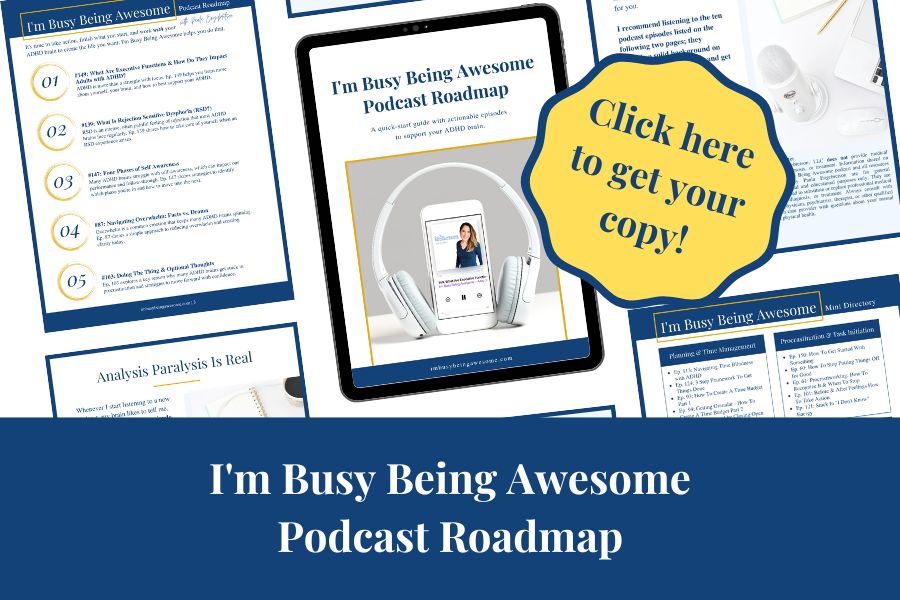
- Get the Podcast Roadmap here
- Join Overwhelmed to Action Free Training here – June 6-8
Join Our Group Coaching Program – We’re Busy Being Awesome!
Add your name to the waitlist!
A four-month small, supportive group coaching program for adults with ADHD and ADHD tendencies.
To learn more check out We’re Busy Being Awesome. Are you ready?