
I don’t know about you, but when I’m trying to figure out a next step, my brain loves to offer “I don’t know.” Maybe you can relate. Maybe you’re working through something at work, trying to understand why a conversation didn’t go as planned, or maybe you just want to decide what you want to eat. And instead of an answer, your brain just offers… I don’t know.
For those of us with ADHD, indecision can show up constantly and in all kinds of situations. And a lot of the time, that “I don’t know” response feels completely reasonable, so we just accept it. In some areas of life, that’s fine. There are plenty of things we genuinely don’t know, and it doesn’t really matter — we leave it there and move on.
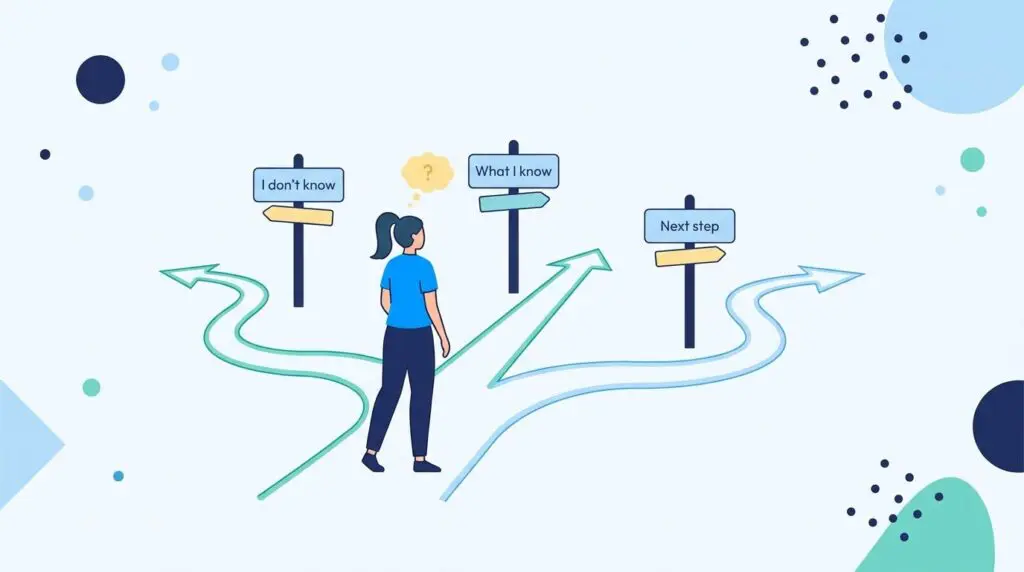
But there are also areas where ADHD indecision keeps us stuck. Where we feel like we’re spinning, not making the progress we want, or feeling frustrated without really understanding why. And that’s where it’s worth pausing and doing a little more inquiry.
In this episode, we’re exploring a two-part framework for working through “I don’t know” — plus three coaching questions that can help us move from spinning into action.
Listen to the episode above or stream it on your favorite podcasting app. Prefer to read? No problem. Keep scrolling for a summary of key takeaways.
In Episode 364, we’re exploring:
- The two very different types of “I don’t know,” and why it matters which one you’re dealing with
- Why our ADHD brains default to “I don’t know”
- Three coaching questions to help you move through indecision and find your next step
The Two Types of ADHD Indecision
Before we can work through “I don’t know,” it helps enormously to identify what kind of “I don’t know” you’re actually dealing with. There are two very different things happening when our brain offers that thought.
Type 1: An External Knowledge Gap
The first type is when you genuinely don’t have the information or the skill set yet. You don’t know how to set up that email sequence. You’ve never used that software before. You don’t know the answer because the answer lives outside of you, and you haven’t encountered it yet.
This is a true knowledge gap, and there’s nothing wrong with it. It certainly doesn’t say anything about your worth or your value. (And I offer this as a loving reminder, because sometimes our brains will tell us that because we don’t have this information, we’re somehow less than. That’s just not the case.) A knowledge gap simply means we don’t have the information yet — and if we want it, the next step is to find a path to learn what we need to know.
Type 2: Inner Knowing
The second type is what I think of as inner knowing. I know that sounds a little woo, but I don’t mean it that way. What I mean is knowing what’s going on for you, personally. How are you feeling about that experience? What do you actually want to do about this next opportunity? Why do you think you approached a situation the way you did?
So often, when faced with these questions, our brain offers “I don’t know” just as quickly as it does for the external stuff. And this is where it gets a little ironic: with most of the inner stuff, we’re actually the only people who could possibly have that answer. No one else has access to what’s going on inside you. Only you do.
Think about how often this comes up. How are you feeling? I don’t know. What do you want to do? I don’t know. What do you want out of this next chapter? I don’t know. Where do you want to eat? I mean… I don’t know.
And there is absolutely no judgment here. Please hear me. My brain offers this all the time, too.
I actually think our brains offer “I don’t know” as a kind of protection sometimes. It keeps us from having to sit with something uncomfortable, commit to an answer when we can’t be certain of the outcome, or make a decision that feels risky. And while that impulse makes total sense, it can also keep us spinning without moving forward — which, for those of us navigating all-or-nothing thinking with ADHD, can feel especially familiar.
A Personal Example: Leaving Academia for Coaching
I experienced both types of “I don’t know” in a pretty significant way when I made the shift from working full time in academia to coaching full time.
This was a huge transition for me, and transitions have historically not been my favorite thing. I’m also a 6 on the Enneagram, which, if you know Enneagram, means uncertainty and I are not naturally friends. This was a big leap.
On the external side, there were so many literal knowledge gaps. I didn’t know how to get my own health insurance. I didn’t know how COBRA worked in that in-between time. I didn’t know how to set up my own payroll or find a payroll service. And if I wasn’t careful, my brain would want to make this lack of information mean I shouldn’t make the leap, or that I wasn’t ready. When in reality, these were just things I had never needed to know before, and now I wanted to know them. The path forward was pretty clear: I needed to go find the information.
And then there was a whole other layer of “I don’t know” that was entirely internal. I didn’t know if it was the right time to make the shift. I didn’t know if I’d be able to make this work. I didn’t know if I’d regret leaving the tenure-track job.
The thing about this second kind of “I don’t know” is that I’m truly the only one who gets to decide. So if my brain says, “I don’t know if it’s the right time” — there is nobody outside me who can answer that. It’s something I get to decide and choose to believe. And whether I’d regret the decision… regret comes from a thought like “I wish I had done that differently.” Whether or not I choose to think that thought, or something else like “I’m so glad I took this bet on myself,” is also within my control. Each time my brain offered “I don’t know” in that inner space, it was an invitation to pause and get curious — to figure out what I did know and how I wanted to move forward.
The First Step: Identify Which Type You’re Dealing With
Before reaching for any of the questions below, the single most helpful thing you can do is notice which kind of “I don’t know” you’re working with.
Is this an external knowledge gap, where the information lives outside of you and you can go find it? Or is this inner knowing, where you’re actually the only person who could possibly answer this?
Identifying this — and truly seeing it for yourself — is huge. It changes everything about how you move forward.
Curious about one-on-one coaching?
Less spinning, more momentum.
Coaching built for how your ADHD brain actually works.
3 Coaching Questions to Move Through ADHD Indecision
Once you’ve identified which type of “I don’t know” you’re working with, these three questions can help you get unstuck. The first is especially useful for knowledge gaps. The second and third work well for both.
Question 1: How Do We Find Out?
When your brain offers “I don’t know how to do this,” instead of stopping there, follow up with: okay, how could we find out? Where can we figure it out?
Then let your brain brainstorm. Where could you learn this? Who could you ask? What’s out there? YouTube, a mentor, a friend, a quick search, your network or community? Give yourself a handful of options and then choose the one that feels most reasonable or doable.
The goal is to turn the “I don’t know” into a next step, because “I don’t know” doesn’t move — but “I’m going to find out by doing X” does.
Question 2: What Do I Know for Sure?
This one works beautifully for both types of “I don’t know,” and it’s one of my favorites.
When we’re stuck in indecision, it’s easy to feel like we have no information at all. But that’s rarely true. There’s often quite a bit we do know — we’ve just been so focused on what we don’t know that we haven’t paused to look at what we do.
So we ask: if I don’t know that, what do I know?
A work example: Say you launched a new product and you’re sitting with “I don’t know why it didn’t work.” That can feel pretty frustrating. But if we shift to what do we know for sure — well, I know I sent fewer emails than usual. I know the people who did open the email had a really strong click-through rate. I know my open rate was lower than my average. Now we have actual data to work with. Maybe the subject lines need attention. Maybe there’s a timing issue, or something going on with email deliverability. We might not have the complete picture yet, but we’ve moved from “I have no idea” to “here’s what I know, and here’s what I can start exploring.” That’s movement.
An everyday example: Maybe it’s something lighter, but no less prone to spinning: “What should I wear to this event?” and your brain offers “I don’t know.” Pause and ask yourself, “What do I know for sure?” Maybe you know it’s a casual, outdoor BBQ. You know it’s going to be primarily in the sun. You know it’s summer — the third week of July — so it will likely be hot and humid. You know you want something light and breathable, nothing fancy. Honestly, my options for light, breathable pieces are so few given that I live in Minnesota, where this kind of weather is only a few months of the year — it narrows down at least 80% of my closet right there.
By pausing to ask “What do I know for sure?” you give your brain direction on where to go next.
Discover Your ADHD Overwhelm Type!
In less than a minute, you’ll discover your primary overwhelm pattern, understand the obstacles it creates, and get tailored strategies designed for your brain’s natural response style.
Question 3: What Are My Top Three Guesses?
This one is particularly helpful for the inner knowing questions. Why did I respond that way? Why haven’t I taken this step yet? Why does this situation keep coming up for me?
When the brain offers “I don’t know,” follow up with: what are my top three guesses? And the important thing to remind yourself is that they’re just guesses. You cannot get this wrong — there is no right or wrong, because it’s literally your internal experience. We’re just looking for three possibilities.
Example: Say you’re trying to understand why you felt super activated after a conversation at work where a colleague said something critical about another person on the team. You find yourself feeling insecure and doubting yourself, and you hear your brain offering, “I don’t know why I care so much. It’s not like she said it about me!”
This is where we pause and ask: what are my top three guesses?
- I’m really uncomfortable with people talking about others when that person isn’t there to share their perspective. That justice sensitivity is real.
- I started thinking — if she’s saying this about them, I wonder if she’s saying critical things about me to others?
- Her comment was specifically about how the other person pushes back deadlines, and since I also struggle with deadlines sometimes, I felt that criticism toward myself, too.
Three guesses. All grounded in things you actually observed. And from there: which one seems the most true, or is it a combination? And how do we support ourselves as we move forward?
If three feels like too many: Scale it down to one. Ask yourself: what’s one possible option? It’s a gentler on-ramp to the same destination — getting your brain out of the freeze and into some movement.
Bringing It Together: A Framework for ADHD Indecision
When your brain offers “I don’t know,” the first move is to practice the pause and consider which kind of “I don’t know” you’re navigating.
Is this an external knowledge gap — something you can go learn and find? Or is this inner knowing, where you’re actually the only person who has access to the answer?
And then, these three questions:
- How do we find out? Turn the “I don’t know” into a next step by brainstorming how to close the knowledge gap.
- What do I know for sure? Shift your focus from what’s missing to what you already have. There’s often more than you think.
- What are my top three guesses? Give yourself permission to explore three possibilities — or just one, if that’s where you need to start.
The real invitation here is to sit with that “I don’t know” a little longer before accepting it as the final answer. So often, there’s so much waiting on the other side of it. Let’s support ourselves through this and give our brains the space to actually find out.
Work with Paula:
- 6-Month Private Coaching
- We’re Busy Being Awesome (small group coaching)
- Overwhelm to Action (self-paced course)
Resources From This Episode:
More ADHD Resources:
- Discover Your ADHD Overwhelm Type – Free Quiz!
- Get the I’m Busy Being Awesome Podcast Roadmap
- Free course: ADHD Routine Revamp
- Learn my Top 10 Tips to Work With Your ADHD Brain
- Discover my favorite ADHD resources
- Access the I’m Busy Being Awesome Planning System
Paula’s Favorite Resources
Many of the items below are affiliate links with discounts and free trials available. They are all products I personally use and love. I may earn a small commission if you make a purchase through my links, at no extra cost to you. Thanks for your support! Disclosure info here.
- Stay focused with brain.fm and get a 30-day free trial. Personalized music, backed by science, designed to help you get and stay in the zone.
- Speechify: my go-to text-to-speech app. One-month free trial plus $60 off a premium subscription if you decide to keep it.
- Todoist: my favorite task manager. Simple, easy to use, and incredible integration with other platforms. Get two months of premium free. No credit card required.
- Wispr Flow: The best tool for talk-to-text. Awesome for verbal processing and saving time. Free trial, no credit card required.


About Paula Engebretson
ADHD COACH | PODCASTER
I spent the first 31 years of my life thinking I just needed to “try harder” while dealing with crushing self-doubt, perfectionism, and imposter syndrome. Then I was diagnosed with ADHD.
Finally understanding the missing puzzle piece, I discovered how to work with my brain, build upon my strengths, and take back control of my life.
Now I help others with ADHD do the same. Learn more.