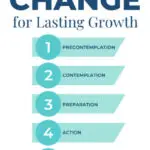
Change is a process, and whether we’re aware of it or not, we all move through five distinct stages or change whenever we shift our habits or behaviors.

Back when I was a professor, grading papers used to take me forever. I’d overthink every comment. I worried about how my students would react. And the entire process dragged on for hours days.
What’s more, I didn’t realize how much this one area slowed me down in my overall productivity…
That is, until a colleague joked that I spent more time grading the papers than the students spent writing them. 🤦♀️ It was a total eye-opener. I had no idea that things could be different. I just assumed, “This is how long grading takes me.”
Looking back, I now see that I was in the earliest stage of change known as “precontemplation.” And once I saw it, my brain shifted into the second stage of change—contemplation—as I thought to myself, “Okay, this isn’t working. What can I do to make grading easier?”
From there, I gradually moved through the remaining three stages, including preparation, action, and maintenance. I asked for tips from colleagues. I simplified my grading process. I set clear limits for myself. And I finally found an approach that worked for my brain.
It made all the difference. If you feel stuck in an area of life and are ready for change, the first step is in recognizing it.
But the next step is not making the change.
Yes, you read that right. 👆
Rather, there are two critical stages that must happen first, which ultimately contribute to creating sustainable change.
In episode 279 of the I’m Busy Being Awesome podcast, we’re breaking down each of these five stages of change and exploring how you can use this powerful framework to create lasting change in your life.
Then tune in below! Let’s do this.
You can listen to the episode above or stream it on your favorite podcasting app here.
Prefer to read? No problem! Keep scrolling for a summary of the key takeaways.
In Episode 279: You Will Discover
- The five stages of change
- Why this framework is especially supportive for ADHD brains
- How to apply this framework to make lasting change in your life
This post contains affiliate links, meaning I may earn a small commission if you make a purchase through my links, at no extra cost to you. Disclosure info here.
Episode #279: Understanding the 5 Stages of Change for Lasting Growth (Transcript)
Hey friends! So, let me ask you—have you ever wondered why it feels so hard to make changes stick?
You’ve got the best intentions, you’ve made the plan, but for some reason, those changes just don’t seem to last? If you’re nodding along right now, I feel you. You’re not alone, especially if you’re someone with ADHD. We’ve all been there, right?
Here’s the thing: Change isn’t supposed to happen overnight. It’s a process—something that happens in stages—and that’s what I want to dive into today.
There’s this really helpful framework called the Transtheoretical Model of Change, developed by psychologists Prochaska and DiClemente back in the 1970s.
They explain that when we go through a change—whether it’s starting a new habit, breaking an old one, or creating a whole new routine—we actually move through five distinct stages.
Understanding these stages can make a huge difference, especially for those of us with ADHD brains.
So before we get too deep, let me give you a quick rundown of what these five stages are.”
Introducing the Five Stages of Change
Stage 1: Precontemplation
At this point, you’re not even thinking about change. You’re just going about your life, engaging with the world, doing your thing, and the idea of making a change isn’t even on your radar. Maybe you haven’t noticed that something needs to shift, or it just doesn’t seem that important yet.
Stage 2: Contemplation
This is when you start noticing that, ‘Hmmm, maybe things aren’t working as well as they could be.’ You start reflecting on patterns, habits, or situations that need to change.
This is where you really begin to think about what’s not working, why it’s important to change, and how your life might be different if you did.
Stage 3: Preparation
Now this is where you’ve decided, ‘Okay, change is necessary. I’ve gotta do something about this.’ And so, you begin making plans. Maybe you’re researching tools, asking for advice, or getting the resources you need.
You might also start sharing your intentions with others, setting up small steps to help you get ready.
Stage 4: Action
This is the stage where you’re actively making the changes you’ve been planning. You’re putting in the work, shifting your behaviors, and creating new routines. It’s full of effort, and it’s where real transformation starts happening.
Stage 5: Maintenance
Now, this is the stage that often gets overlooked, but it’s so important. This is all about sustaining the change over time. It’s easy to feel like, ‘I’ve done it, the hard part is over,’ but maintaining the changes we’ve made takes continuous effort.
If we’re not careful, however, it’s super easy to slip back into old habits—totally normal, by the way! This is where we really need support and reminders to keep going.
Why These 5 Stages of Change Are So Powerful

So, why is all of this so powerful for those of us with ADHD?
This model helps us understand that change isn’t just about flipping a switch. It’s not a one-step process. Our ADHD brains tend to think in black and white, that we’re either doing it or not.
I love this framework because it reminds us that it’s about moving through each stage, in our own time. And for those of us who might get overwhelmed easily, knowing that there’s a structure—where each stage builds on the next—can make this whole process feel a lot more manageable.
What I find especially fascinating are the first three stages—Precontemplation, Contemplation, and Preparation.
These are what I think of as the foundation stages. They’re so crucial because they lay the groundwork for everything that follows. Without these steps, we wouldn’t be ready to take action, let alone maintain those changes.
Here’s what’s fascinating to me: It’s so easy for us to dismiss these stages because we don’t see immediate results.
I know for me, I used to think, ‘Well, if I’m just thinking about change, it doesn’t count.’ Or, ‘I’m still preparing, so I’m not doing enough.’
(Does your brain ever offer this, too?)
We feel like we’re not moving forward because we’re not seeing instant wins, but here’s the truth—these stages are essential steps in the process. Just because you can’t see the change yet doesn’t mean it’s not happening.”
We Can Shift Our All or Nothing Mindset
This is where we can start to break free from that all-or-nothing mindset, which – as I just mentioned – so many of us with ADHD struggle with.
We tend to think, ‘If I’m not taking action right now, I’m failing.’ But when we understand that these foundational stages are part of the journey, we can give ourselves permission to honor where we are in the process.
It’s not about jumping straight to action or perfection. It’s about giving ourselves the space and time to move forward at our own pace. And that’s okay!
Embrace Self-Compassion
The most beautiful part of all this change of thinking is the opportunity for self-compassion that comes with it.
Instead of beating ourselves up for ‘not doing enough,’ which comes so naturally to many of us, we can recognize that…
- Thinking about change is progress
- Reflecting on what’s not working—that’s progress.
- Preparing, researching, and gathering resources—that’s progress.
It’s all part of the process. Every step, no matter how small, counts.
When we can see it this way, it can help reduce our regular practice of constant self-criticism. We can celebrate every little win along the way, and trust that we’re still moving forward, even if we’re not at the ‘action’ stage yet.
I really want to reinforce this idea: Change is not a one-step process. And wherever you are in these stages, you are making progress. And that deserves to be celebrated.
So let’s talk about what that process looks like specifically.
Below I’m diving into: These five stages of change and understanding what they look like and the role they play.
Because the more we understand them, the more we can identify and navigate change with confidence—without getting stuck or feeling overwhelmed.

Stage 1: Precontemplation (The Stage Where You’re Not Ready)
To put this phase into context, let me give you an example from my own life.
Back when I was a professor, grading student papers used to take me forever. But it wasn’t because I was trying to make everything perfect. No, it was deeper than that—I was so worried about upsetting my students with the feedback.
I dreaded the idea of them confronting me, asking why I graded it a certain way, or feeling bad about their writing. So, I would spend hours tweaking my comments, giving tons of examples to justify the grade, and trying to anticipate every possible reaction they might have.
I created so much unnecessary work for myself, all in this effort to control how they would respond to their grades. Spoiler alert, this is an impossible task because we can’t control other humans!
But at the time, I didn’t even realize this was a problem. I thought, ‘This is just how grading goes. It takes this long.’ It wasn’t until a colleague joked, ‘You can’t spend more time grading the papers than the students spent writing them!’ that I had this huge wake-up call.
I was completely stuck in this behavior, without realizing how much it was weighing me down.
Here’s the thing—being in precontemplation is okay.
Sometimes, we’re just collecting data and experiences. We don’t know something’s not working because it hasn’t come to light yet. Or we haven’t gotten to the point where the discomfort becomes noticeable enough to think about changing.
So if you’re in this stage, give yourself some grace. It’s all part of the process.
For me, in that example, it took an outside perspective to get me to see that what I was doing wasn’t working. Sometimes, we don’t even realize we’re stuck because we’ve normalized the struggle. It just feels like the way things are.
Here’s what naturally happens—at some point, you start to notice the discomfort.
Whether it’s through someone else’s comment or because the frustration becomes too much, you begin to realize, Oh, this is not working. That’s when you move from precontemplation into contemplation.
It’s that moment of recognition where you start thinking, ‘Hmm, maybe there’s a better way.’
Stage 2: Contemplation (Where We Start Thinking About Change)
This stage of change is all about thinking about change.
We haven’t acted yet, but now it’s on our radar. You start noticing patterns, maybe asking yourself questions like, ‘Is this really working for me?’ or ‘Could things be different?’
It’s that place where we know something needs to shift, but we’re not quite sure how to make it happen. And for a lot of us with ADHD, this is where we get stuck—thinking and thinking, but not moving forward just yet. So let’s break down what contemplation looks like.
Let me share some examples:
Struggling to Create a Morning Routine
You know your mornings are chaotic and leave you feeling rushed and stressed.
You’ve been thinking for a while that you need a better routine to help you feel more grounded, but the idea of actually setting it up feels overwhelming.
You keep telling yourself, “I’ll figure this out next week,” but you haven’t taken any real steps to change it yet. If that sounds familiar, it might be the contemplation stage.
Thinking About Setting Boundaries at Work
You’ve noticed that you’re saying “yes” to way too many requests at work, and it’s stretching you thin.
You’re considering setting some boundaries—maybe saying no to a few projects—but you worry about how people will react. The idea of having those conversations feels stressful, so you keep contemplating it without taking any steps yet.
Pondering a Social Media Break
You’ve realized that spending hours on social media makes you feel drained and distracted.
You’ve been thinking about taking a break or setting limits, but actually doing it feels daunting. You’re not sure how to fill that time or what it will feel like to disconnect, so you keep contemplating it without taking any action.
As I mentioned earlier, This is often where we tend to get stuck. We know something’s off—we recognize the need for change—but the ‘how’ seems overwhelming, or too hard, or unfamiliar, or it’s not uncomfortable enough to make us actually do something different.
Instead, we think about it constantly, and when the thought of making the change comes up, we freeze.
Here’s what I want to stress about the contemplation stage: Thinking about change is progress. I know it doesn’t always seem like it, but reflecting on what’s not working is an essential part of the journey.
Even if you haven’t acted yet, you’re starting to bring awareness to what needs to shift, which is a huge step. So give yourself credit—you’re moving forward, even if your brain’s telling you you’re not.
Stage 3: Preparation (Where We Get Ready to Act)
Now, after spending some time in contemplation, where you’re thinking about change but haven’t acted yet, something starts to shift.
You begin to feel ready. You’re no longer just thinking about the ‘what ifs,’ but instead, you’re starting to think, ‘Okay, what do I need to do to make this happen?’
This is where we move into preparation. It’s that stage where you’re not quite in action mode yet, but you’re gearing up for it.
You’re gathering your resources, doing your research, and figuring out what needs to be in place before you can take that first step.
Example
Let’s dive into what that looks like with an example from my own business.
When I first brought on a VA for my team, I quickly realized that my usual paper system for keeping track of tasks and projects just wasn’t cutting it anymore.
Suddenly, I had to manage all these moving pieces—assigning tasks, tracking progress, and keeping everything organized. And honestly, it felt like everything was discombobulated.
I couldn’t remember what I’d asked her to do, what was already in motion, and what still needed to be handled. It was overwhelming, and I knew something had to change—hello, contemplation stage.
But rather than diving straight into trying to fix everything at once, I took a step back and moved into the preparation phase.
I started researching different tools, exploring project management systems, and asking around to see what other people in similar positions were using.
That’s when I rediscovered my love of Todoist, which quickly became a game-changer for my team. I spent time learning how to use it with others, testing out features, watching some YouTube videos on how others have done it, and figuring out how to integrate it into my workflow.
This is what the preparation stage is all about: gathering your resources, asking questions, and making small moves to get ready for action. You’re laying the groundwork and making a commitment to change, but you’re doing it in a way that feels manageable. It’s all about setting yourself up for success before diving in.
Now, we want to be careful about not getting stuck in this stage – and this is true for all of the different stages, of course.
I want to call out this stage in particular because this is where many of the front-end perfectionists love to hang out.
We think, ‘I just need to prepare a little more. I need to gather a few more resources. I’ll make the change when I’m really ready.’
And while preparation is essential, it can also be a sneaky way to avoid taking action, especially when we feel uncertain or fear not getting it right on the first try.
So for those of you who may find yourself hanging out in this space for a while, I want to highlight it as a loving reminder That wildest stage is key, there is also and allure of staying here for some of us
If you’re in this stage right now, remember that taking small steps is key. Maybe it’s researching tools like I did, or even just creating a list of options to explore. One step at a time.
👉 Side note: If you’re curious about using Todoist for project management and task management, you can use this link for > 2 free months off their Pro Plan. No need credit card needed! I’ve been using it for years, and I absolutely love it.
Stage 4: Action (Doing the Thing)
You’ve gathered the resources, you’ve asked the questions, and you’ve laid the groundwork. We’ve now reached the stage that most of us actually recognize as “working toward change.”
Once again, I want to highlight that there has been so much work done already. All of these stages that we’ve already looked at needed to happen before this stage. They were all required.
We now reach action. This is where the rubber meets the road, where all the preparation turns into actual steps forward. It’s also the stage that takes the most mental and emotional energy because you’re now doing the thing.
Now, I won’t go into a lot of story here because I’m quite certain most of you know what this looks like. Again, this is the stage most of us associate with taking action.
So, let me give you some brief examples inspired by our contemplation stage before.
Starting a New Routine:
You’ve been contemplating and preparing for a new morning routine—maybe mapping out different wake up times based on your schedule, deciding on possible workouts you might do, Looking at simple breakfast options you could use, etc.
Now you’ve made those decisions and you’re ready to give them a try. You’re taking those first steps and trying out iteration 1.0. You’re waking up earlier, going for that morning walk, and making time for breakfast.
You’re in action mode, and you’re doing your best to stick with it more times than not.
Setting Boundaries at Work:
You’ve thought about it, prepared your talking points, and The action phase is where you actually have those tough conversations with your boss or your colleagues about setting better boundaries.
You’ve been in the discomfort of saying no to the extra projects, and you’re enforcing those boundaries.
Taking a Social Media Break:
After contemplating and preparing for a while, you decided to log out of social media or set time limits on your apps or delete them from your phone. It’s been difficult, but it’s been a few days and although it’s really uncomfortable, you also notice that increase in both time and mental space.
–
Taking action is where all of the preparation turns into visible steps forward.
It’s the stage where other people might notice what’s changing, and I’m going to stress once again for the people in the back, it is so important to recognize that getting to this point takes tremendous effort.
For those of us with ADHD, taking action—especially on something that’s been weighing on us—requires a lot of mental energy and focus. So, it’s essential to celebrate every step that led up to this moment as well.
For all my clients, this is why I repeatedly talk about celebrating your wins. This is why I created a Count Your Wins Journal. We need to recognize our progress in order to maintain that momentum regardless of the stage we’re in.
Stage 5: Maintenance (Sustaining the Change)
Finally, we arrive at maintenance—the stage that often gets overlooked but is so important.
This stage is all about keeping the changes we’ve made and sustaining them over time. And here’s the thing: it’s really tempting to think, ‘I’ve done it! The hard part is over.’
But let me tell you, maintaining the changes we’ve worked so hard to implement also takes continuous effort. And I’m not saying this to discourage you or dissuade you from working toward changes. I’m saying this to help prepare you for the moments when things feel hard. Let’s break it down.
When we’re in maintenance, it’s easy to think we’ve crossed the finish line, but the reality is, the finish line keeps moving.
Just because we’ve taken action doesn’t mean the change automatically sticks.
This stage requires constant attention because the pull to slip back into old habits is always there. And let’s be real—life happens, distractions pop up, and suddenly, we find ourselves drifting back into what’s familiar.
For those of us with ADHD, this stage can feel especially tough
We might get bored with the routine, lose interest, or forget the systems we put in place. And if we’re not careful, all the progress we’ve made can start to unravel.
That’s why maintenance isn’t just about keeping the change going—it’s about staying intentional and reminding ourselves why we made the change in the first place.”
How do we stay in this stage of Change without slipping back?
The key here is support and reminders.
Maintenance is where we need to build systems, accountability, and self-reflection, and self coaching into our daily lives. It’s about staying connected to what’s working and constantly checking in with ourselves.
It’s also about putting in Practical support to make maintenance easier, whether that’s creating accountability with a coach, a friend, an app, etc.
Using visual reminders and cues, self-reflection and self coaching, all of these different options can be really useful in helping sustain the incredible changes you’ve made.
Recap of the Five Stages of Change:
We’ve just walked through the five stages of change according to the Transtheoretical Model of Change:
- Precontemplation—when we’re not yet aware that change is needed.
- Contemplation—when we start thinking about change but aren’t ready to act yet.
- Preparation—when we gather the resources and make plans to move forward.
- Action—when we finally start implementing the changes.
- Maintenance—when we work to sustain the changes we’ve made over time.
Each stage plays a crucial role, and I also want to stress that—despite the way I presented it today—the process is not inherently linear—you might find yourself moving back and forth between these stages.
And that’s okay! Change is a journey, not a straight line.
Next Steps

This week, I encourage you to get curious about where you are in these five stages of change.
Take a look at different areas of your life—whether it’s your work, personal routines, relationships, health, etc.
To help you figure out where you are in your own process, here are a few questions to reflect on:
- Are you noticing something in your life that’s not working, but you haven’t started thinking about how to change it yet? That might be Precontemplation.
- Are you thinking a lot about a change you’d like to make but haven’t made any moves toward it yet? If so, you might be in Contemplation.
- Are you researching tools, gathering resources, or making small plans for a change? That’s likely Preparation.
- Have you started actively working on a change—whether it’s starting a new routine, setting boundaries, or taking action on something you’ve been putting off? If so, you’re in Action.
- And finally, are you working to maintain the progress you’ve made, knowing that staying persistant takes effort and intention? That’s Maintenance.
I encourage you to start identifying where you are within these five stages throughout the week. Get curious and observe where you are—no judgment, just awareness.
Please also remember that whatever answers you find are awesome! You see…
In order to get where we’re going, we have to know where we are first.
Think about it like this: a GPS doesn’t work if it doesn’t know your current location. I can’t tell Google Maps to get me to the airport if it doesn’t know where I’m at right now. The same is true when we’re figuring out where we are within our stages of change.
We need to know where we’re at in order to figure out the next steps in the process.
When you identify your current stage, you help yourself navigate change more effectively. What’s more, you can stop beating yourself up for not being in a different stage and start honoring where you are.
From there, you can plan your next move with more clarity and confidence, knowing that you’re on the right path.
Now, if you’ve been listening and thinking, ‘Okay, but I still feel stuck,’ I hear you. For so many of us with ADHD, it’s easy to get bogged down in the action or maintenance phases.
You’ve done the preparation, maybe you’ve even started taking those first steps, but keeping that momentum going can be hard. And “falling off track” during maintenance?
It’s so common that I think they should have put it as another stage in the model of change. So if you’re struggling to take action or continue that maintenance phase, please know you’re not failing. This is a perfectly human thing to do. And there might be an opportunity for some troubleshooting or some adjustments.
Let’s Talk
If you’re feeling stuck in one of these stages—whether you’re struggling to move from contemplation to action, or you’re finding it hard to maintain the changes you’ve worked so hard to make—let’s talk.
I’d love to help you create your own systems that actually fit your ADHD brain. We’ll work together to set up structures that help you maintain the momentum, fuel the dopamine, and practice self-compassion – all of which are absolutely critical during the change process.
👉 You can learn more about my small group coaching or my one-on-one coaching sessions
Alright my friends, that’s going to do it for us this week.
🎄 Don’t forget – if you want to streamline your holidays and focus on what matters most to you and your loved ones this season, be sure to grab my holiday season blueprint HERE! It’s packed with over 70 pages of resources and guides so you can shape the season to work best for YOU.
Also, do you know someone who would love to learn more about these five stages of change? If so, would you be a rockstar and share this episode with them? Perhaps send it in a text message or snap a screenshot of the episode and share it on your Instagram stories. Whatever you do, please know that I so appreciate you for both tuning in and for helping me get these strategies to even more busy awesome brains who need them.
Until next time, keep being awesome. I’ll talk with you soon.


About Paula Engebretson
ADHD COACH | PODCASTER
I spent the first 31 years of my life thinking I just needed to “try harder” while dealing with crushing self-doubt, perfectionism, and imposter syndrome. Then I was diagnosed with ADHD.
Finally understanding the missing puzzle piece, I discovered how to work with my brain, build upon my strengths, and take back control of my life.
Now I help others with ADHD do the same. Learn more.