Traditional productivity advice tells us to do more, move faster, stay consistent – you’ve heard it before with hustle culture’s constant demand to optimize every minute. But for us ADHD brains, that formula doesn’t just backfire – it leaves us feeling defeated, wondering why we can’t “get it together” like everyone else.
The endless unfinished to-do lists, productivity systems that work for three days before collapsing, and the guilt from starting strong then fizzling out all point to needing a better way.
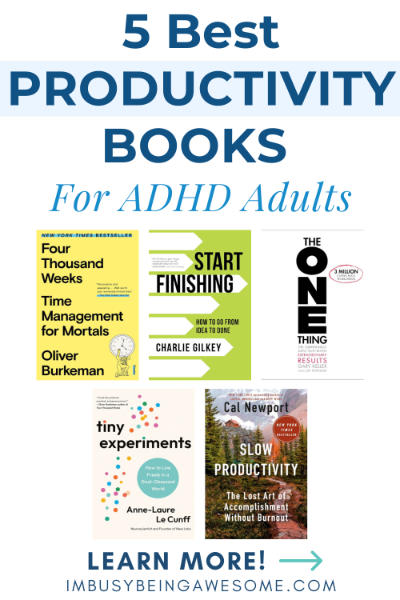
In episode 320 of the I’m Busy Being Awesome podcast, we’re exploring five powerful books offering a different approach – one that works with our ADHD brains instead of against them.
These aren’t typical “wake up at 5 am and CRUSH IT” guides, but thoughtful frameworks honoring how our unique brains function and giving us permission to work differently. Let’s get into it.
Listen to the episode above or stream it on your favorite podcasting app. Prefer to read? No problem! Keep scrolling for a summary of the key takeaways.
In Episode 320, You Will Discover:
- The top 5 productivity books for ADHD brains
- Why these books have been especially impactful
- How to identify which book will give you the biggest wins right now
–
This post contains affiliate links, meaning I may earn a small commission if you make a purchase through my links, at no extra cost to you. Disclosure info here.
Episode 320: 5 Best Productivity Books for ADHD Brains (Transcript)
Today, we’re diving into part two of our ADHD book series. You can access part one here: 8 Must-Read ADHD Books for Women.
In part one, we focused on books that help us understand our ADHD brains more deeply. Books that explore emotional insight, self-compassion, and the internal experience of living with ADHD.
That episode was all about creating a strong foundation. Because before we jump into doing the things — building systems, trying new routines, following advice — I think it’s so important that we take the time to understand what’s actually going on in our brains.
This self-awareness work gives us clarity. It helps reduce shame. And it sets us up for success when we do start taking action.
Which brings us to today. Part two is all about the doing, but not in the traditional hustle-culture way.
The 5 books I’m sharing with you today weren’t written specifically for ADHD brains; however, they do offer powerful ideas that we can adapt and build on — especially when we’re intentional about pulling out the themes that support our way of working.
The books below are divided up by themes, helping you find what you need right now, from:
- Doing more to meaningful doing
- Rushing to finding your rhythm
- Chasing the perfect plan to bravely taking the next step
From Doing More To Meaningful Doing
This shift is all about stepping away from the endless pressure to do everything — and instead learning how to focus on what actually matters to you.
When we’re working with ADHD brains that are prone to overwhelm, urgency spirals, and chasing every shiny task we think we “should” be doing… this shift is a game changer.
The two books I want to highlight are Oliver Burkeman’s 4,000 Weeks and Gary Keller’s The One Thing. And honestly? These two books have both had a huge influence on my own mindset over the years — especially when it comes to how I prioritize and plan my time with ADHD.
You’ve probably heard me reference The One Thing a million times — whether we’re talking about prioritizing your daily anchor task, or creating clarity around what “done” looks like. And just recently, in episodes 310 The Work is Never Done and 306 the insecure overachiever and how Oliver Burkeman’s work really helped me unpack these experiences. Of course, I’ll link to those in the show notes if you want to explore them further.
But today, I want to zoom in on what makes these two books so impactful, especially when we’re trying to move away from overcommitting and start building a more sustainable relationship with our time.
The key here is self-compassion. These books aren’t meant to scare us or make us feel like we’re behind. So check in with yourself when you’re reading. If you’re feeling tight or anxious, take a breath. When we can step into the mindset from a place of curiosity, they can really offer liberation from the never-ending pressure to do it all — and help us create a more intentional, sustainable rhythm that supports how our brains actually work.
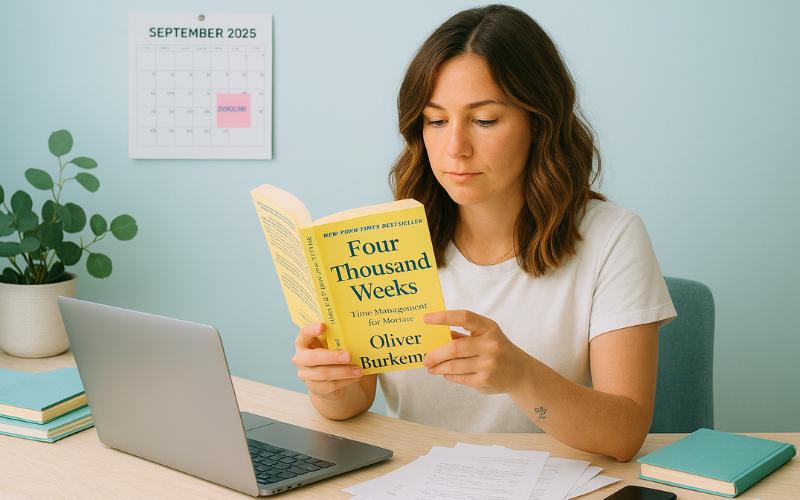
1. Four Thousand Weeks, Time Management for Mortals – by Oliver Burkeman
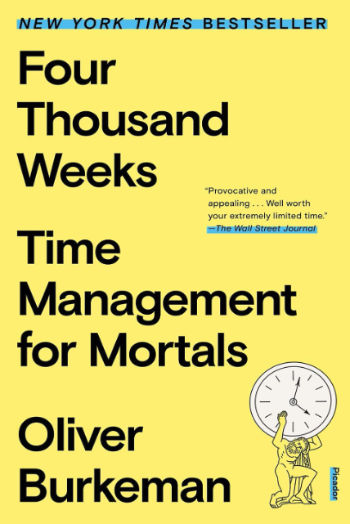
The title alone sets the tone — Four Thousand Weeks is roughly the number of weeks we have in an average human lifespan. And I’m not going to lie- this can be a bit sobering… and at the same time, also really clarifying. Once I sat with the reality for a while, it was actually a relief.
Burkeman’s core message is this: we are never going to get everything done. And that’s not a personal failure. That’s just reality.
What I love about this book is how it gently (but firmly) pushes back on the fantasy that we can optimize or out-plan the limits of being human. And as you know, one of my favorite reminders for all of us – myself included – is that we’re humans, not robots.
He explores the illusion of control and how we try to conquer time by doing more, being more efficient, and crossing off every item on the list. And ironically, how that quest for more is actually what keeps us stuck in this constant state of urgency and frustration in the first place.
Key message: Stop chasing the illusion of total control and instead ask, what do I want to make space for?
This message is so powerful for ADHD brains, because we live with time blindness, and we tend to underestimate how long things take. We say yes to everything, chase new ideas before finishing the last one, and then we wonder why we’re so exhausted and overwhelmed.
Burkeman’s work offers a permission slip to step off that treadmill — and start choosing intentionally what gets our time and energy.
Best fit for:
- Those of us who feel constantly behind and overwhelmed by how much there is to do
- People stuck in the loop of perfectionism, trying to “catch up” or “stay ahead”
- Those who struggle with time anxiety and want a more compassionate relationship with time
- If you’re looking for a mindset shift more than a tactical system
How you’ll benefit from Four Thousand Weeks:
- You’re always thinking, “I just need to get my life under control.”
- You feel pressure to squeeze productivity out of every moment.
- You want permission to slow down and focus on what really matters — not just what’s urgent.
If any of those sound like you, this could be a great book for you.
Keep in mind when reading: With Four Thousand Weeks, facing the reality of the time we actually have could also leave the brain feeling a little panicky, and rather than clarifying, it instead fuels us to try and do more, which kind of defeats the point.
2. The One Thing: The Surprisingly Simple Truth About Extraordinary Results – by Gary Keller

While Burkeman zooms out to offer big-picture perspective, Keller zooms in with a question that I come back to almost every day:
“What’s the one thing I can do such that by doing it, everything else will be easier or unnecessary?”
Now, that question can get a bit wordy, but he’s basically asking, “What’s the one thing that would have the biggest impact right now?”
The One Thing is a masterclass in prioritization. And while it wasn’t written for ADHD brains, I honestly think it is such a powerful resource for those of us who feel scattered or pulled in a thousand directions.
Keller introduces the idea of a “domino effect” — that when we identify and complete the right task, it makes everything else easier. But to do that, we have to be willing to name what matters most. Not everything that’s important. The one thing that’s most important right now.
For ADHD brains, this is such a powerful tool.
Because when we look at our entire to-do list — or our entire week — it’s easy to feel overwhelmed and try to do it all at once. But this book reminds us that we don’t have to do everything today. In fact, we probably can’t.
But we can ask, “What’s the one thing I want to move forward right now?”
That clarity can quiet the chaos.
Best fit for:
- Those of us who feel scattered or unsure where to focus
- People who are juggling multiple goals or responsibilities and need clarity
- Those who want a concrete, actionable approach to prioritizing what matters
- If you’re looking for more of a tactical, clear framework and love a “guiding question” style of productivity
How you’ll benefit from The One Thing:
- You’re constantly asking, “Where do I even start?”
- You find yourself doing a million small tasks but never feel done.
- You’re craving focus, simplicity, and direction — without the fluff.
Keep in mind when reading: When trying to implement The One Thing, it can be easy to hyperfocus on choosing the “perfect” task or spin in indecision about which “one thing” to choose and never actually get started.
Moving From Rushing to Find Your Rhythm
So often, we ADHD adults are operating under this low-level urgency.
- We’re trying to catch up.
- Prove ourselves.
- Keep pace with an invisible standard that says: faster is better.
- More is better.
- Rest means you’re lazy.
👉 What if we asked instead: What would it look like to slow down?
What if we could:
- To honor our natural energy rhythms?
- To give ourselves space to think?
- To move through projects in a way that builds capacity instead of burning it up?
This is the mindset behind Cal Newport’s Slow Productivity.
3. Slow Productivity: The Lost Art of Accomplishment Without Burnout – by Cal Newport

Now, if you’ve read any of Cal Newport’s work before — like Deep Work or Digital Minimalism — you know he’s all about intentional focus., however in Slow Productivity, he’s doing something a little different. This book isn’t about maximizing output or becoming a machine. It’s about doing less, but doing it better.
His core argument is that our current approach to productivity — especially in the field of knowledge work — is unsustainable.
We’re constantly task-switching, juggling too many commitments, and pushing ourselves beyond capacity in the name of being “productive.” And ultimately, that leads to burnout, shallow work, and poor outcomes.
Instead, Newport introduces a slower model of productivity that centers around three principles:
- Do fewer things
- Work at a natural pace
- Obsess over quality – which I’ll flag here can be a slippery space for us perfectionist brains.
And while this wasn’t written specifically for ADHD, there is so much we can take from it — especially the idea of working at your natural pace.
For ADHD brains, energy is inconsistent. Our executive functions aren’t consistently reliable. We rarely move through things in a steady, linear flow.
We need novelty. We need rest. We need to recover from intense focus or overwhelm. We are thoroughbreds rather than workhorses when it comes to our working style, so when we push ourselves into a rigid, consistent routine, we flame out.
Slow Productivity gives you permission to build a rhythm that works for you.
ADHD Pitfalls to Watch For:
As supportive as these ideas are, there are a couple of common traps our brains might fall into, and I want to flag them here:
1. The principle of “do fewer things” can spark all-or-nothing thinking
- We might tell ourselves, “Well, I can’t do fewer things — everything is important,” or “If I don’t do it all, everything will fall apart.”
- This mindset keeps us stuck in overwhelm, because we believe there’s no room to adjust.
- It’s easy to slip into “must be nice” mindset and believe it’s not for us, but I think there’s definitely wisdom in this first concept of Slow Productivity for most of us.
2. “Obsess over quality” can get real slippery for ADHD brains, especially if you struggle with perfectionism
- We might get caught in endless tweaking, redoing, or never feeling like something is “done enough.”
- So if your brain hears “obsess” and thinks “that means perfect,” this is your gentle reminder: it’s about deep work, not flawless work.
👉 Therefore, the key is self-awareness. Check in with yourself and ask:
- Am I using this principle to support myself?
- Am I slowing down to focus — or getting stuck in the name of perfection?
Best fit for:
- Anyone running on empty, chasing deadlines, or pushing themselves to the edge, this book might be a powerful invitation to try something different.
- You’re feeling burnt out or chronically overwhelmed
- Those who’ve tried every system, but still feel like it’s never enough
How you’ll benefit from Slow Productivity:
- You’re craving more ‘ll be able to create more breathing room, depth, and meaning in your work
- You want permission to slow down and build something real
From chasing the perfect plan to bravely taking the next step
And this one’s huge for ADHD brains — especially those of us who love to gather information, map out ideas, research frameworks, and color-code our Notion dashboard before ever starting the project. (No judgment — I love a beautiful Notion dashboard.)
This shift invites us to pause that pattern. To stop chasing the polished blueprint and instead ask:
“Based on the information I have now, what’s the next best step?”
The two books that beautifully support this mindset are Charlie Gilkey’s Start Finishing and Anne-Laure Le Cunff’s Tiny Experiments.
4. Start Finishing: How To Go From Idea To Done – by Charlie Gilkey

Charlie Gilkey’s Start Finishing is one of those books I find myself both turning to myself and recommending to others when the familiar phrase, “I have this big idea or project I really want to do… but I can’t seem to get started.”
You see, this book is all about bridging that gap between idea and action.
What I love most is how Gilkey breaks big projects into manageable, actionable pieces; it’s such a supportive approach.
Instead of trying to hold the entire project in your brain all at once (which, let’s be real, quickly leads to overwhelm), Gilkey helps you name the building blocks and get momentum one small piece at a time.
Potential roadblock: It’s easy to fall into over-planning (we might spend more time building the scaffolding and never get around to starting), so I want to keep this on your radar. To avoid this roadblock: Practice putting a container of time around the planning phase to help ensure you’re taking that forward action, too.
Speaking of which, I also love that he talks a lot about the internal resistance that comes with meaningful work. The fear of starting. The temptation to tweak the plan one more time. The voice that says, “Let’s organize the task list again instead of actually doing the thing.”
And for ADHD brains? That internal resistance is so real. Whether it shows up as perfectionism, distraction, or avoidance — this book helps you recognize what’s happening and offers tools to move forward.
Best fit for:
- You have a big idea or goal that matters to you — but you never seem to start
- You love to plan but struggle to follow through
- You want a practical structure for mapping out your projects in a way your brain can actually hold
5. Tiny Experiments: How to Live Freely in a Goal-Obsessed World – by Anne-Laure Le Cunff

Tiny Experiments brings the author’s background in neuroscience together with the approach of tiny experiments.
The core idea is that we do NOT need a perfect plan. We just need a simple hypothesis and the willingness to try something small.
Le Cunff invites us to approach behavior change like a curious scientist. Instead of putting pressure on ourselves to make the “right” decision or execute a flawless strategy, we simply test something. We gather data. We notice what works and what doesn’t. And we adjust.
Not surprisingly, this approach is incredibly ADHD-friendly. It breaks through perfectionism, overthinking, and fear of failure by lowering the stakes. There’s no huge commitment. No all-or-nothing thinking. Just a willingness to try, learn, and move forward.
It’s the same mindset I’ve talked about in past episodes when we explore the power of thinking in containers of time, of establishing “good better best goals” the importance of iteration and learning from each try. It’s about creating motion without pressure.
Best Fit If:
- If you’re someone who’s been waiting to start until the conditions are perfect, the plan is complete
- You feel overwhelmed by making the “right” decision
- You’re stuck in perfectionism or fear of failure
- You’re craving a light, curious approach to change without that heavy pressure
- You finally feel ready to make a massive change
This book might be just what your brain needs to start small and build from there.
About the Author, Anne-Laure (Because I’m a huge fan!)
Anne-Laure is a neuroscientist, writer, and founder of Ness Labs, and essentially, she has this blend of curiosity, science, and mindful productivity and presents it in such an accessible way.
Her background is fascinating:
She started out working in tech at Google, but after a personal health scare and reevaluation of her life, she made a pivot into neuroscience.
She went back to school in her late twenties, earned a Master’s and PhD in psychology and neuroscience, and now focuses her research on curiosity, lifelong learning, and – I think more recently – ADHD specifically, which I’m so excited about.
Her Approach:
Her approach is not done through pressure or hustle, nor is she super prescriptive and preaching the “one right way” to do things. Instead, she encourages small, intentional experiments rooted in curiosity.
She’s helped thousands of people rethink how they approach growth through her website Ness Labs, her writing, and now Tiny Experiments.
Common Themes Across All 5 Books
I want to take a moment to zoom out and highlight a few common themes that run through all 5 of the books we discussed. These themes guide us as we create our own ADHD-friendly approach to productivity.
Across the board, these books invite us to consider the following…
1. Permission to do less
Each author, in their own way, challenges the pressure to do more, faster, all the time.
Whether it’s through clearer priorities, sustainable pacing, or tiny experiments, they invite us to release the unrealistic expectations and focus on what actually matters.
2. Focus on meaning over metrics
These books encourage us to ask, “What’s meaningful to me?” instead of “How much can I accomplish?”
That reframe is everything for ADHD brains — especially when we’re tempted to measure our worth by how productive we’ve been.
3. Build external structure to support Internal motivation & capacity
From scaffolding your projects to identifying your “one thing” to testing tiny experiments, these strategies all help take the pressure off your working memory and give you a place to anchor your focus.
Similarly, they help us find a rhythm that’s aligned with who we are and what works best for our brains.
So if any of these ideas resonated with you today, then one of these books might be a great next read for you.
How To Use These Productivity Book Recommendations
Firstly, think of these books as resources – tools you can pull from, not boxes you have to squeeze into.
Let’s be honest, most mainstream productivity advice is built for neurotypical brains. It assumes predictable energy, a linear focus, and overarching consistency.
When we try to force ourselves into the systems that tell us to do more, move faster, push through — it’s not only a struggle, but we often end up feeling worse.
That’s why these five books I’m reviewing today are so powerful. They offer supportive, flexible mindsets for getting things done — ones that we can actually adapt to our own brains, our own needs, and our own seasons of life.
Instead of giving you a rigid framework to follow, I’m inviting you to listen for what resonates with you.
Take what helps. Leave the rest. Use these ideas to shape a productivity philosophy that actually feels like yours.
Final Thoughts: Productivity That Feels Like You
If there’s one message I hope you take from today’s episode, it’s this:
You don’t need to follow anyone else’s system perfectly. You don’t need to optimize your life down to the second, and you definitely don’t need to “earn” your rest by hustling harder.
Instead, what if we gave ourselves permission to experiment?
- To build scaffolding that actually helps us start — without overengineering.
- To prioritize what truly matters — without needing to justify it.
- To slow down and create room for deep work that actually matters to you — even when the world tells us to speed up.
I see these books as invitations to reimagine how we think about time, focus, and follow-through.
👉 They remind us that productivity isn’t about doing more, it’s about doing what matters most in a way that actually works for you.
To get started:
- Choose the book or the mindset that speaks to you most
- Try something tiny. Reflect. Tweak. Keep going
- As always, be kind to yourself in the process
👉 Ready to apply these Concepts to your life?
Here’s how we can work together:
- 6-Month Private Coaching
- We’re Busy Being Awesome (small group coaching)
- Overwhelm to Action (self-paced course)
✨ Learn my simple step-by-step approach to locking in a routine and making it stick, be sure to check out my free course, the ADHD Routine Revamp.
Resources From Episode 320:
- Four Thousand Weeks by Oliver Burkeman
- The One Thing by Gary Keller
- Slow Productivity by Cal Newport
- Start Finishing by Charlie Gilkey
- Tiny Experiments by Anne-Laure Le Cunff
- Episode 315: 8 Must-Read Books for Women with ADHD
- Episode 310: The Work is Never Done + Accepting Unfinished Work
- Episode 306: The Link Between the ‘Insecure Overachiever’ and ADHD
- Episode 288: How To Master ADHD Goal Setting by Energy Type
- Episode 287: ADHD Energy Type: Are You a Thoroughbred or Workhorse
- Episode 150: How to Get Started with Something – Thinking In Containers of Time
More ADHD Resources:
- Discover my favorite ADHD resources
- Learn my Top 10 Tips to Work With Your ADHD Brain
- Access the I’m Busy Being Awesome Planning System
- Get the I’m Busy Being Awesome Podcast Roadmap


About Paula Engebretson
ADHD COACH | PODCASTER
I spent the first 31 years of my life thinking I just needed to “try harder” while dealing with crushing self-doubt, perfectionism, and imposter syndrome. Then I was diagnosed with ADHD.
Finally understanding the missing puzzle piece, I discovered how to work with my brain, build upon my strengths, and take back control of my life.
Now I help others with ADHD do the same. Learn more.