
When springtime rolls around, does your brain think about spring cleaning?
Mine does.
And while I’m the first to admit that cleaning’s not at the top of my “how I like to spend my time” list, it sure feels good when it’s done.
You too? I thought so.

Unfortunately, spring cleaning can also seem like one big obstacle course for our executive functions when we have ADHD.
Self-monitoring, planning, prioritization, task initiation, organization, impulse control, and emotional regulation… we require each of these skills at some point throughout the process…
…and these skills are much more challenging for our brains.
But here’s some good news.
There are supports we can put in place to simplify the process and make the steps much more manageable.
And that’s exactly what we explore in episode 191 of the I’m Busy Being Awesome podcast.
You can listen to the episode above or stream it on your favorite podcasting app here.
Prefer to read? No problem! Keep scrolling for the entire podcast transcript.
In This Episode, You Will Discover
- How to best approach the spring cleaning process for your ADHD brain
- The different stages of the process
- Actionable, step-by-step instructions to begin your spring cleaning today
Leave IBBA A Rating & Review!
If you enjoy the podcast, would you be a rockstar and leave a review? Doing so helps others find the show and spreads these tools to even more people.
- Go to Apple Podcasts
- Click on the I’m Busy Being Awesome podcast
- Scroll down to the bottom of the page where you see the reviews.
- Simply tap five stars; that’s it!
- Bonus points if you’re willing to leave a few sentences sharing what you enjoy about the podcast or a key takeaway from the episode you just heard. Thanks, friend!
Episode #191: 5 Action Steps for Spring Cleaning with ADHD (Transcript)
Hello everybody. Welcome back to the podcast. How are you? This episode comes out on March 20th, which means that, in the Northern Hemisphere, anyway, we are officially kicking off the start of spring. It’s here. And I am delighted. I love spring.
I love it when the snow starts melting and the grass shows. I love it when the new buds show in the trees, and I love the bright, variety of colors that start popping out of the monochrome of winter. It’s filled with fresh starts, energy, and the promise of longer days. And I just love it.
Now I’ll also admit that in my mind, spring also brings a correlation to spring cleaning and clearing out. And again, I personally love this – even though I know not everyone feels the same. And that’s totally okay. But I personally love the idea of getting out the excess clutter to make more open space, getting myself organized, and – when it warms up a little more where I’m at – opening up the windows for some fresh air, too.
I have a sneaking suspicion that I’m not the only one whose brain makes this connection.
Everyone may not love spring cleaning as much as I do, but I do think a lot of us have this correlation between spring and getting our spaces cleaned and organized.
In fact, I think many of us tend to have this itch with changes in the seasons generally, which is great. I think it’s beautiful when we can find ways to sync with the seasons in different ways.
For you amazing listeners in the southern hemisphere, I know I get this same itch to get my space organized in the fall. So what we’re talking about on the podcast today absolutely applies to you, too, even if it’s not technically spring.
Spring Cleaning And ADHD = Overwhelm

Now, while we may have these connections in our mind between the spring season and spring cleaning, I know that for many ADHD brains and people with ADHD tendencies, we can also feel rather overwhelmed thinking about the process itself.
Before we go any further into the episode, I want to normalize this.
Whether you love decluttering, getting organized, and spring cleaning and you dive right in. Or whether you love the idea, but thinking about implementation makes your brain want to melt. Or whether you dread the idea and the implementation both, you’re not alone. And it makes sense.
To put this into context, let me break down how that process might go (your brain is thinking…)
1. I don’t know where to start
It feels totally overwhelming thinking about all the different areas it needs to deal with throughout your home.
2. This is going to take too long
Then maybe you calm the toddler brain and you make a decision about where to start, but then your brain offers the next reason it’s hard, which is “this is going to take so long. I don’t have time for all of this.”
3. I can’t believe you let it get this bad
From there, maybe you set aside some dedicated time to work.
You map it out in your calendar, and you make sure that that space remains open.
But when the time comes to follow through on that plan, you might feel a sense of frustration or shame or embarrassment because your brain is telling you stories like, “I can’t believe you let it get this bad. Why did you allow yourself to buy so much stuff? You don’t wear any of these clothes anyway.” Or whatever else your brain offers you.
4. Now this is overwhelming
You work through that negative brain chatter, and suddenly you’re faced with the executive functioning challenges of sorting through all the items in your closets and drawers.
You have to make decisions about what to keep and what to donate. And the whole time, you’re trying so hard not to get distracted from all of the distracting things in your room.
Frankly, I find this can be one of the most challenging parts of the process. How many of you have opened up boxes or drawers or storage bins to begin the decluttering process, only to resurface an hour later after going down memory lane and playing with all the things you found? I know I’m not the only one here.
Again, I put all of this into context, not as a means to discourage or dissuade you, but rather to normalize that this process is challenging for many of our brains. So if you find yourself struggling or feeling resistant to getting started, nothing’s gone wrong. But also, there are strategies and tools that we can put in place to help us move forward on these goals.
Let’s Do A Check In
Before we talk about those specific tools, however, I first think it’s important to check in with yourself and get clear on whether you actually want to do this process.
Is this a full-body yes that you genuinely want to do, or is this an intellectual yes that you think you “should” do because it’s spring and you’re listening to a podcast episode that’s talking about cleaning and organizing?
If it’s the latter, please give yourself radical permission not to do this right now.
If you genuinely don’t want to, or you don’t have the capacity for it, beautiful. You can either keep listening and use the strategies that I talk about in another area of your life or keep it in your back pocket for when you do feel a genuine desire to get started.
Or you can skip to a different episode. At the time of this recording, there are 190 others you can pick from.
So please don’t use this episode against yourself, telling yourself you “should” spring clean if it’s not a full body yes when you think about diving in and getting started on one small area or space in your home.
I love the work of K.C. Davis; she explains that these types of tasks are morally neutral. You’re not better if you do them. You’re not worse if you don’t do them. They are morally neutral.
So, if you don’t feel pulled to this right now, brilliant. No problem at all. And if you do feel pulled to do some decluttering and organizing right now, brilliant. Let’s do it. And let’s do it in a way that feels aligned for you.
What Does Decluttering Mean To You?
This brings me to my first point in the process, which is to check in on what “decluttered,” “organized,” or “clean” means for you.
These are terms that all mean very different things to different people. One person’s preferred level of organization or clutter or cleanliness might be much different from someone else’s level, and that’s beautiful.
As long as you have your living space in a way that allows you to function well, that’s all that matters.
Just as with scheduling, where some people thrive with more structure and other people with less structure, the same is true with levels of clutter and organization. So please be on to yourself if your brain tells you the story that you need to have a Pinterest-perfect space if that doesn’t feel good for you.
As long as your space allows you to function and show up in the way that you want to, that’s exactly right.
I encourage you to get clear on what that level of organization is for you. And if you don’t know, no problem.
The first step is…
- Experimenting and finding what feels best. And you can use the strategies that we talk about today to help you find that.
- I also suggest using the tools and the strategies that we talk about today and confining them to one room or one part of one room in your home.
Don’t overwhelm yourself with trying to do the whole space. Instead, try the process out. Use it to see what’s supportive for you.
Your brain may feel tempted to do all the different areas in the home at once. But I promise you, as we’ve talked about throughout different episodes of this podcast, when we can constrain our focus to one area and make progress in that one area, that’s what really gets the ball rolling.
That’s what helps us build momentum and show our brains that we can do this. We can make progress. We can make a plan, stick with it, and follow through to the end. So after you define the level of organization and cleanliness that feels good for you, choose one room or one part of a room where you want to begin.
Why Do You Want To Declutter?
I also suggest that you remind yourself why you want to do this. Why is it important to you to go through this process?
I assure you, your brain, at some point, will question your decision. It will think, “why are we doing this again? This is taking forever. Why did I think this was a good idea again?” So, spending a little bit of time, ahead of time, reminding yourself of why you want to do this, will make a big difference.
I know that when I go through this process, it ultimately helps me save time, which I love.
When I have less stuff in the way, I have a much easier time finding what I want to use.
Building on that, I also have less visual distraction generally. There’s less clutter in my visual space, which I find is often reflected as less clutter in my mind.
And then, finally, I find that when I go through this process, it allows me to genuinely enjoy what I have even more.
I’m reminded of what I have, I’m intentionally keeping what I want, and again, because I have less pulling at my attention, I get to enjoy the things that I kept. So I encourage you to remind yourself why you want to go through this process, too.
5 Action Steps For Decluttering & Organizing

And that brings us to the action steps of the decluttering and organization process, and in this section, we have five parts within the framework.
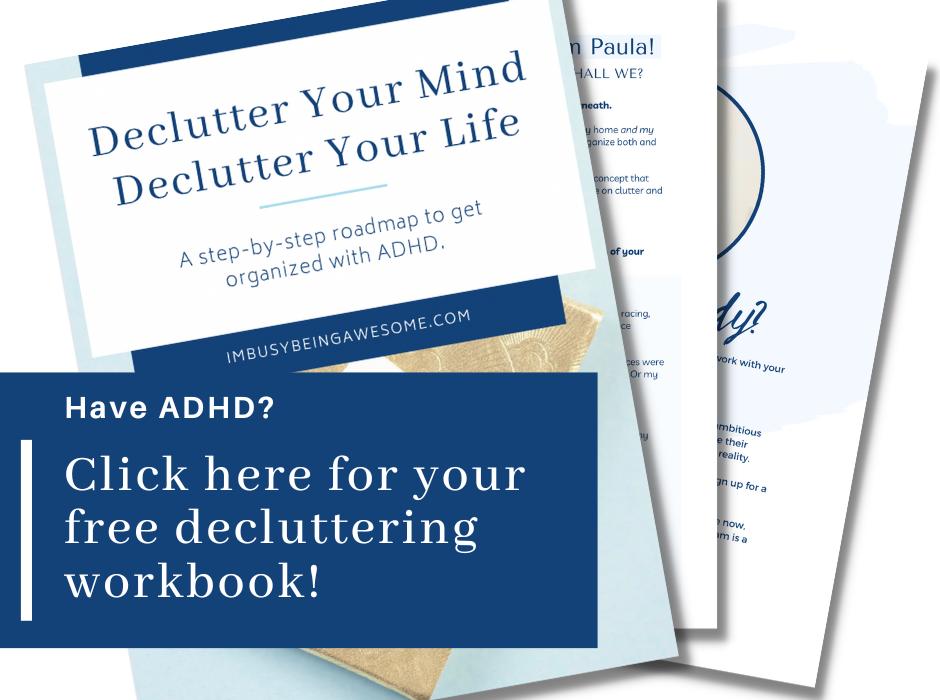
Also make sure to download the free decluttering roadmap…
Step 1: Get Rid Of All Trash Or Recycling
Get a garbage bag and a paper bag and go through the space, only picking up trash and recycling – nothing else.
Your brain will want to tell you to slow down and start organizing or decluttering or making decisions about this thing or that thing.
Remind yourself that you will get to that. But right now, you are picking up the things you know are clearly garbage. Pick up the mile-long receipts from CVS, the excess papers, any wrappers or tags or soda cans, or junk mail. Depending on the room that you’re in, you may have more or less of this, but by doing this first, you’re getting rid of that first layer of stuff, which makes the next steps so much easier.
Step 2: Determine What Doesn’t Belong
Ask yourself, what doesn’t belong in this room or this space?
In this situation, I like to get a couple of bins, or I just create separate piles in the room for the items that belong in different areas of the house.
If I was doing this in my office, I would have a bin or pile for…
- Things that belong upstairs in my bedroom
- Items for the kitchen
- Things for the bathroom, etc.
Then I would begin step two of sorting through the next layer, which is all the things that don’t belong in this room- in this case, my office- and I put them in the corresponding bins or piles.
So if I were actually doing this right now, my coffee mug and bowl from breakfast would go in the pile for the kitchen. The book that I’m reading and the sweatshirt on the back of my chair would go in the pile for my bedroom. I have three hair scrunchies and a pair of earrings on my desk that would go in my pile for the bathroom etc. And if there was more, I would keep going until I had everything that doesn’t belong in this room divided into corresponding piles.
Now you get to decide what to do next – choose your own adventure!
If the first two steps of picking up garbage and sorting through what doesn’t belong went relatively quickly, you might do one of two things (before moving on to step 3).
Option 1: Put those bins outside of the room and continue to step three
If you made piles instead of using bins, now is the time to grab some bins or baskets to put your piles into.
Option 2: Take each bin and put the things away before step three
If you choose option 2, I’d recommend setting a reminder in 15 minutes to come back to the room in which you’re working, just in case you get distracted. If you’re anything like me, a lot can distract you between bringing bins from the office to the bedroom, bathroom, and kitchen.
–
Alternatively, let’s say that the first two steps took quite a bit of time. If that’s the case, maybe you take the bins, put the respective items away, and decide when you’ll return to the next steps another day after you’ve been able to rest. You know yourself best, and you know what would feel most supportive for you.
The reason I offer this second option is that we all have different levels of energy, and we don’t want to push ourselves past the limit and into burnout, where we completely dread the process. We want to do this when we have the energy. This is also why I suggested starting very small with one room or one portion of one room. Maybe it’s one side of the closet or one drawer in your desk. This makes the entire exercise so much more manageable.
So let’s say you’ve decided to continue on, and it’s time to start step three.
Step 3: The Decluttering Phase
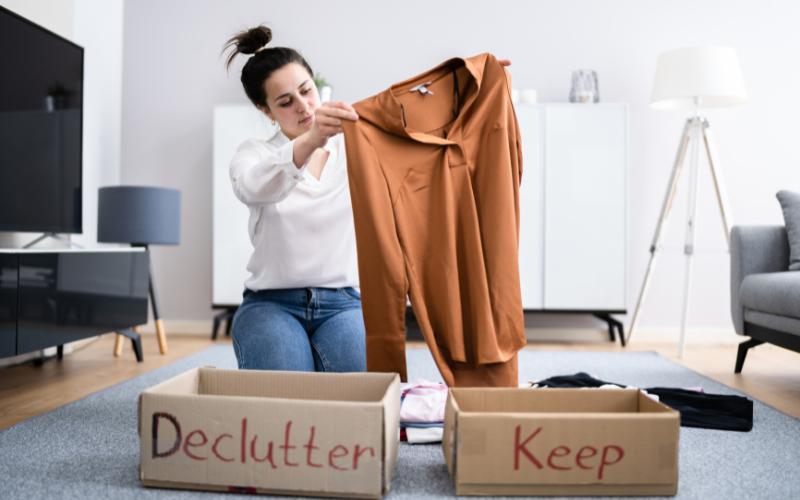
What I like to do here is ask myself a set of questions.
To start, download my free decluttering roadmap. It walks you step by step through the process. It also provides a decision tree that helps you decide what to keep and what to donate.
I will offer a handful of questions here comment too. But I do encourage you to grab the extra questions and the roadmap.
When starting to declutter I love to ask myself:
- How many sets of these things do I need? For example, if I’m going through my office, and I have tons of different pens, how many pens do I actually need?
- How often do I use this? When is the last time I used it?
- Do I enjoy using this thing? Would somebody else enjoy this item much more than I do? Would it get more use with somebody else?
- Would I buy this again now? If the answer is no, I donate it or throw it away if it’s not in good enough condition to donate.
Since I’ve been going through this process a lot recently, I’ve also been asking myself frequently, do I want to move this across the country? This one often helps me separate from things that might otherwise feel challenging to release.
So again, as you go through the decluttering process, focus on one area of one space and go through these questions.
Follow the sequence in the organization road map, and let that guide you as you consider each item.
I also suggest that you check in on yourself.
- How are your energy levels?
- How are you feeling?
- Are you ready to begin the next drawer, or do you need to take a break and step away for a little while?
This third step requires so much decision-making, so be sure to take care of yourself.
Step 4: Organize
It’s time to put things back into their respective places. Chances are you will have quite a bit more space after decluttering and getting rid of the things you no longer need or use, so putting things away may be a little bit less challenging.
When I go through the organization process, I have two sets of questions that I’d like to ask myself.
What do I want easily within reach?
And what can be stored out of reach? Another way you might ask this is, what do I want easy access to? And what’s okay if it requires a bit more work to access?
For example, even though it takes up space, I want my podcast equipment to be easily accessible. If I had to go down to the basement to get all of my equipment and set it up each week, I would be much more likely to avoid it. But because I have everything on my desk set up and plugged in. And I have some sound curtains that I can easily pull up to stop some echo in my room, it makes things much easier.
I can be set up and ready to go in about 30 seconds.
On the other hand, I have a backup camera for my computer and a backup mouse and keyboard in case I need it. I have certain books that I like to refer to often enough that I want them in my office, but so often that I need it directly on my desk. These can all take a little bit more effort for me to access. It’s okay if they’re tucked away in a drawer and require a little bit more work. I don’t need them all the time.
So again, ask yourself,
- What do I want within reach?
- What’s okay if it’s a little more inconvenient to reach?
As a side note, you can use this question to help you with changing habits or routines as well. You can create more friction or less friction depending on the habit you want to establish or break by asking yourself that same question as you organize your space.
What do I want out of sight?
The second set of questions I like to ask myself when organizing is: what do I want out of sight, and what do I want in sight? I know this seems very similar to the last set, but the way that I use the questions is a little bit different.
My working memory is quite poor, and I am very much a person where things are out of sight and truly out of mind.
Now, this is okay in some situations. For example, it’s okay if I have my extra whiteboard markers in a drawer in my cabinet. When my whiteboard marker dries up, that’s probably enough to remind myself that I have some extras in the drawer. If not, it’s not the end of the world. But usually, it is enough to remind me.
There are other items, however, that I want to keep on open shelves so I can easily see them and remember they exist. Or I keep them right on my computer desk so I can’t miss them at all. For example, I do this with my planner. It sits right next to me, open to the current day, so I can remember what I’m doing each hour.
You could also use this question of in sight or out of sight to decide whether you want to store items in clear bins or opaque bins.
For example, maybe you have storage totes in your bathroom. And in opaque totes, you have extras of things. Extra toothpaste, lotion, makeup, whatever. But you also have a clear bin where you store the items you currently use, so it’s easy for you to see where they’re at and remember what you have. Or maybe you prefer everything to be in a clear tote so you have a visual of everything.
By organizing and putting away items according to how easily you want them in reach and how visible you want them to be, you’re ultimately creating that organizational system that’s most supportive of your brain.
Now, you may stop there. I know this is an episode on spring cleaning and we haven’t talked about the actual cleaning yet, but I know some people already have a pretty regular cleaning routine, and others have the support of professional cleaners who come in regularly, and if that’s the case, you’re done!
But if you want to move on to the final part of the spring cleaning process, that’s what we’re looking at next. And I should also mention that it’s possible you skip the first section of decluttering and organization because you love the exact amount of things you have in your space and all you need to focus on is the cleaning.
If that’s the case, amazing! Just focus on this section.
Step 5: The Cleaning Part

Now just as I mentioned that people have different preferences regarding decluttering and organization, the same is true for cleaning.
We all have different approaches and definitions of what it means to clean.
So I am going to provide an overview so your brain has that structure, and then you can adjust it as needed to fit your approach. Sound good?
First and foremost, I don’t recommend doing all of this at once. Frankly, I don’t think it’s possible. So if you’ve spent a lot of time already decluttering, let yourself rest and tackle the cleaning when you’ve had a break.
Create A Checklist
When you’re ready to dive in, I recommend creating a checklist of the rooms you want to clean and the steps for each room.
Again, this releases the demand on our executive functions of needing to decide in the moment, and it also helps ensure you stay focused on what’s most important.
I’ve been known to be cleaning out the linen closet upstairs, run downstairs for a glass of water, and suddenly start organizing the pantry in the kitchen. So having that list is helpful for keeping you on track.
Gather Your Supplies
Up next, you’ll want to gather your supplies. So get all of the supplies and equipment you’ll need before you start, which will save you time and help ensure you’re ready for each step of the cleaning process.
Begin Cleaning
Then we begin cleaning. And I’m going to share the order of cleaning that I’ve learned, but again, if you have an approach that you like, awesome. Use it! Whatever feels best for you. But the order I like to follow is
- Dust: Starting from the top and moving downwards, dust all the surfaces: ceiling fan, shelves, furniture, windowsills, etc. I love to use the Swiffer duster for this – not a sponsor, I just like them.
- Vacuum: Vacuum floors, carpets, upholstered furniture, and any corners or hard-to-reach areas.
- Clean: Wipe down hard surfaces with whatever cleaner you like to use. So wipe down the counters, toilets, sinks, bathroom walls, and mirrors, desktop, kitchen table or island, etc.
- Mop: Then finally, I like to mop the hard surfaces.
- Air out: If you can, open the windows and let in the fresh air to clear everything out.
Tip: You may do this process one room at a time, one floor at a time, or maybe you stick to one step throughout the whole home at a time. I can see the benefits to each approach. I tend to do one floor at a time. So I start upstairs and do all the dusting, then all the vacuuming, then all the cleaning, then the mopping. Then I move downstairs and repeat. But again, you do you. There’s no right way to do it.
Don’t Forget To Take Breaks
The final thing I want to say about this entire process is – again – be sure to take breaks. Don’t push yourself. Also, celebrate yourself for taking action. This is not necessarily a fun activity. It may be enjoyable when it’s over, but it’s not always super fun in the moment, and you’re doing it.
Also, Recruit Help
This doesn’t have to be all on you. Ask your kids or your roommate or your partner to help. If you have the means, hire a professional cleaner or organizer to help you with a portion – or all – of the process.
You could even call up a friend and ask if they’ll do it with you in exchange that you go over and help them with their house. It’s a build in body double and friend to talk with. Get creative, and remember you don’t have to do it all your own, unless that’s what you prefer to do.
Let’s Recap
All right, I know this episode had a lot of information in it, so I’m going to go through a quick recap of the steps.
- Checking in to ensure that we genuinely want to do this process – we want to ensure that it’s a full body yes and not an intellectual “should.”
- Get clear on the level of clutter and organization that feels supportive for you.
- Choose the one space where we’ll focus our attention, and we remind ourselves of why we want to do this.
- Begin the five-step framework:
- Do the first layer of trash and recycling.
- Gather up the things that don’t belong in the current space and separate them into bins or piles to eventually put away.
- Start the decluttering process using the questions from that road map.
- Move into organization, as we consider what items are okay to be out of sight and which items do we want easily visible. And which items do we want easily within reach? And which ones can take a little bit more effort to access?
- Begin the cleaning process (if doing) – create a checklist of your process or do a quick google search for a checklist online. Gather the supplies and then move through the rooms dusting, vacuuming, cleaning the surfaces, mopping the floors, and airing thing out.
Throughout the entire process, we are checking in on our energy levels and taking breaks as needed.
Final Thoughts
Whew! Thanks for sticking with me. I know we covered a lot today, and I’d love to hear what you’re taking away from it. Let me know over on Instagram. I am @imbusybeingawesome. I can’t wait to hear from you.
Alright, my friends, that’s going to do it for us this week.
If you’re ready to take these concepts deeper and apply them to your life. If you’re ready to learn how to support your ADHD in a way that works for YOU, then I invite you to learn more about my small group coaching program, We’re Busy Being Awesome. And if it sounds like a great fit for you, you can add your name to the waitlist so you’re the first to know when the next cohort begins.
Join Our Group Coaching Program – We’re Busy Being Awesome!
Add your name to the waitlist!
A four-month small, supportive group coaching program for adults with ADHD and ADHD tendencies.
To learn more check out We’re Busy Being Awesome. Are you ready?
Also, have you grabbed the podcast roadmap yet? It has the most popular episodes all detailed for you so you can get yourself up to speed and ready to work with your ADHD brain. Access now!
Until next time, keep being awesome. I’ll talk with you soon.